Album Review – Belnejoum / Dark Tales of Zarathustra (2025)

A newborn Symphonic Black Metal beast will tell the story of Zarathustra’s corruption and insanity in its debut opus, utilizing symphonic elements combined with oriental and traditional classical instruments.
A Symphonic Black Metal project founded by Egyptian vocalist and multi-instrumentalist Mohamed Baligh “Aswad”, who’s currently located in the United States, utilizing symphonic elements combined with oriental instruments like the naey and traditional classical instruments such as the violin and cello, Belnejoum is unleashing upon humanity its debut album, entitled Dark Tales of Zarathustra. Mixed and mastered by Fredrik Nordstrom at Studio Fredman, and featuring an array of more-than-special musicians the likes of Fabio Bartoletti (Fleshgod Apocalypse) and Ehab Sami on the guitars, Rich Gray (Annihilator) on bass, Francesco Ferrini (Fleshgod Apocalypse) on all orchestral arrangements, George Kollias (Nile) on drums, and Tamara Jokic on Melisma vocals, as well as guest musicians Hany El-Badry on the naey, Mohamed Medhat on the violin, tenor Christian Correra on vocals, and Jeremy Garbarg on the cello, Dark Tales of Zarathustra tells the story of Zarathustra’s corruption and insanity, his journey to the underworld on the back of a demon named Aeshma, the witnessing of the horrors of Hell, and his suicide as his final act, as he no longer sees a purpose for living.

The opening track Prophet of Desolation couldn’t have sounded more atmospheric, cryptic, doomed and multi-layered, with George sounding inhumane on drums while Aswad roars deeply in the name of Black Metal. Not only that, all background orchestrations elevate the song’s epicness to a whole new level. The Day Zarathustra Turned Dark is more like an interlude than a song per se, darkening the skies before we face Tower of Silence, where the guitars by Fabio and Ehab match perfectly with the orchestral sounds crafted by Francesco; whereas the crying violin by Mohamed will penetrate deep inside your soul in On Aeshma’s Wings, a ruthless, imposing Black Metal aria where George once again steals the show with his fulminating beats and fills.

Guest Jeremy Garbarg recorded Elegie using a rare cello made by Rugieri in Cremona, Italy in 1695, resulting in a somber tune where Tamara’s minimalist vocals sound absolutely enfolding, flowing into the Symphonic Black Metal beast In Their Darkest Aquarium, with once again their orchestrations, riffs and drums generating a massive wall of sounds tailored for lovers of the genre. Then the melancholic piano by Aswad returns in As She Drowns, warming us up for Upon the Mortal Blight, a ten-minute Black Metal creature where their Cradle of Filth and Fleshgod Apocalypse vein pulses harder than ever, all boosted by another amazing vocal performance by Aswad. The Flames, the Prophet, the Tears is another piano-infused composition by Aswad, soothing our souls and preparing us all for the outro Zarathustra’s Last Requiem, a climatic track overflowing classic sounds, sealing the fate of Zarathustra.

Totaling 52 minutes across ten tracks, Dark Tales of Zarathustra is a stunning musical voyage led by Aswad that will surely take the name of Belnejoum to new heights, and if you want to know more about such an amazing project made in the United States but with pure Egyptian blood you can find all details about it on Facebook and on Instagram, stream its amazing debut on Spotify pretty soon, and above all that, purchase the album from Antiq’s BandCamp or webstore. Zarathustra’s descent into madness couldn’t have been better depicted than through the top-of-the-line Symphonic Black Metal by Belnejoum, offering several layers and nuances that definitely make the whole story even more compelling, and may Aswad and his extreme music beast keep delivering amazing albums like Dark Tales of Zarathustra to us all in the coming years, always sounding unique while remaining loyal to the foundations of Black Metal.

Best moments of the album: Prophet of Desolation, On Aeshma’s Wings and Upon the Mortal Blight.

Worst moments of the album: The Day Zarathustra Turned Dark.

Released in 2025 Antiq

Track listing
1. Prophet of Desolation 10:14
2. The Day Zarathustra Turned Dark 2:49
3. Tower of Silence 5:03
4. On Aeshma’s Wings 5:43
5. Elegie 3:39
6. In Their Darkest Aquarium 6:17
7. As She Drowns 3:17
8. Upon the Mortal Blight 10:28
9. The Flames, the Prophet, the Tears 2:01
10. Zarathustra’s Last Requiem 2:36

Band members
Mohamed Baligh “Aswad” – vocals, piano
Fabio Bartoletti – guitars
Ehab Sami – guitars
Rich Gray – bass
Francesco Ferrini – orchestral arrangements
George Kollias – drums
Tamara Jokic – Melisma vocals

Guest musicians
Hany El-Badry – naey
Mohamed Medhat – violin
Christian Correra – tenor
Jeremy Garbarg – cello
Metal Chick of the Month – Cherine Amr

Metal Goes Egyptian!

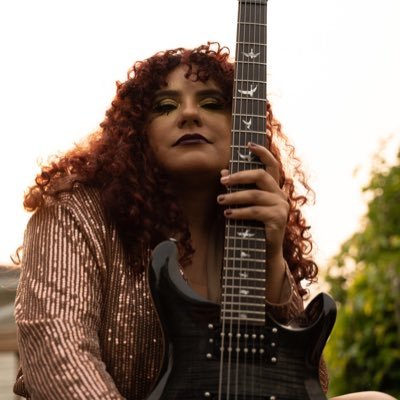
In this month of February, let’s put an Egyptian touch to The Headbanging Moose with a multi-talented lady who knows how to masterfully blend the harshness of heavy music with the whimsical cultural sounds of her homeland, crafting a unique blend that became a trademark in her already solid career in music. Owner of a powerful voice that can range from the most delicate cleans vocals to deep guttural roars, she had to go against all odds to make her music be heard, and we must thank her for being so obstinate because her music is indeed a thing of beauty. I’m talking about Cherine Amr, sometimes also referred to as Cheen, the mastermind behind Massive Scar Era, and a woman who will bravely fight for freedom of speech, for creativity, and for women’s rights, always against any type of oppression, including obviously religious oppression, and always armed with the power of heavy music.

Hailing from the famous and beautiful Mediterranean port city of Alexandria, in Egypt, Cherine got interested in Western Heavy Metal in the late 90’s during her teens thanks to one of her friends, when the genre became popular in Egypt even though the police were known to round up fans for some not-so-nice questioning. That of course didn’t stop Cherine from listening to heavy music and, consequently, from forming Massive Scar Era in the early 2000’s, with all criticism she received in her homeland only fueling her passion for crafting high quality rock and metal since then.

It was in 2004 in her hometown Alexandria when Cherine, alongside Suzie and Sarah Kasrway, formed Massive Scar Era, an Egyptian Alternative Metal collaborative project characterized by a distinctive fusion of Heavy Metal, Progressive Rock, and Punk Rock, spiced up with elements of traditional Egyptian music, reflecting the cosmopolitan allure of Alexandria intertwined with the raw essence of Cairo’s urban landscape. The name of the band is also very meaningful to Cherine. “The name means so much to us. It has many layers and the more the years go by the more we relate to it. We wanted a name that reflects how traumatic and aggressive the world is, that we are living in right now. I was thinking about a good name for a long time, and a good friend of mine in Egypt suggested it to us. Since the band started as an all-girl band at its beginning, Massive Scar Era was also the long name for its abbreviation Mascara; however, we stopped using Mascara a long time ago.”

The band released their debut EP Reincarnation back in 2006, immediately receiving a lot of feedback from all types, including criticism from family members and religious authorities in their homeland. Those struggles were mentioned in the internationally released book Heavy Metal Islam, by author Mark LeVine, in 2008, and the band also faced difficulty in finding gigs and record distributors in their country during that period due to popular disdain for aggressive music.

The international success of Massive Scar Era led the band to play at Sweden Rock Festival in 2009, and to be feature in the Egyptian film Microphone in 2010, showcasing Alexandria’s arts and music scene. The band then went on to release a series of albums starting in 2010, those being Unfamiliar Territory (2010), Precautionary Measures (2011) and Comes Around You (2012), leading them to play at European summer music festivals regularly. Finally, in 2013 Cherine and her Massive Scar Era were featured in the film Before the Spring, After the Fall, which depicted the participation of Egypt’s rock musicians three years before the 2011 Arab Spring.

It was in 2015 when Cherine had to relocate to Montreal, the largest city in Canada’s Quebec province, to escape her home country’s criticism and harassment toward her music, and that change also impacted the way things worked for Massive Scar Era, as Cherine’s creative vision for the project evolved into a more collaborative project where she started inviting a diverse group of musicians to contribute to the band’s sound and bring her vision to life. This approach differs from having a fixed band lineup, enabling Cherine and her guest musicians to explore and experiment with various musical styles and influences while keeping the core elements of the project’s identity intact.

Following her relocation to Canada, Cherine and her Massive Scar Era have already recorded the albums 30 Years (2016), Color Blind (2018), Metal Goes Egyptian (2023), and more recently Assyad (2024), which is perhaps her most experimental album to date. There are also some interesting videos online for some of her best creations, including Pray, School Girls, 30 Years, Color Blind, Unfollow, and the more-than-special series of videos titled Metal Goes Egyptian: Live with an Egyptian Arabic Orchestra, where you can also enjoy her work with visuals as part of her music.

This slideshow requires JavaScript.

Her 2024 album Assyad definitely deserves a listen by any fan of good quality music, and also by any person interested in knowing more about the Egyptian culture and traditions. The album is a result of years of research into the Egyptian Zār traditions, all masterfully transformed into beautiful music by Cherine and her henchmen. Zār is a possession cult that incorporates music and dance into its rituals, aiming to establish reconciliation between individuals and the spirits (Assyad) believed to inhabit their bodies, causing illness. The Assyad represent the projection of fears and anxieties, and the Zār ritual seeks to alleviate suffering, challenges, and conflicts faced by the individual. At the heart of the Zār ceremony, an ensemble guides the devotees through a trance dance, breaking down barriers to personal identity through rhythmic and melodic patterns deeply rooted in emotional and cultural contexts. This allows individuals in a trance to identify with the possessing spirits, providing a unique sensory experience.

It was back in 2021 when Cherine undertook a 20-day residency with Zār musicians in Cairo, Egypt, supported by Dr. Kawkab Tawfik, also connecting deeply with the Zār Abul Al-Gheit Ensemble, led by Mohammed Abouzied. Then in 2023 she united metal and Zār musicians for a three-week residency in Montreal, hosting music workshops to refine their collaboration, resulting in an interactive show at Le Petit Campus on August 18, 2023, and in the album Assyad, blending traditional Zār songs and rhythms with metal, with each track being inspired by a specific Zār spirit.

Ultimately, Assyad makes a powerful analog between two demonized groups; the Heavy Metal audience, and the Zār community, who have both had their music and practices come under scrutiny by society at large. Through the album, Massive Scar Era and The Abou El-Gheit Ensemble invite listeners to embrace the unknown and explore the deep connections between music, culture, and community. Hence, if you want to be part of the unique experience of listening to Assyad, the album is available for streaming in full on BandCamp and on Spotify, and as already mentioned, it’s a must-listen for admirers of heavy music with folk and cultural elements.

There are some very interesting interviews online with Cherine, including this one HERE, and in most of those interviews she’s questioned about how it is to make heavy music in her homeland Egypt, how it felt to be called Satanists by whoever was against heavy music in their country, and everything surrounding the Arab Spring. “Let’s be honest and put things in a realistic perspective; news outlets romanticize insurgency, but when you are in the situation and you know that your life can be taken away, you can literally pee your pants. We were scared! We are still afraid. I moved to Canada because of this,” commented Cherine. “If I haven’t left Egypt, I would probably have toned it a little bit down. Currently, the government is on edge and arresting anyone that looks suspicious to them, and our case wouldn’t get the public support.”

A huge lover of Molokhia, an iconic Egyptian soup made of jute mallow leaves from which the dish gets its name, Cherine dreams of playing with Massive Scar Era at Wacken Open Air, bringing her Egyptian roots, arts and music to a much broader metal community, and I’m sure her dream will come true sooner than later due to the high quality and depth of her music. I can already imagine her Egyptian sounds hypnotizing tons of headbangers at the biggest metal festival in the world, allowing her to show the entire world that heavy music has no boundaries, no religion, no gender, and so on, evolving into a symbol of freedom even in places where political and religious oppression has sadly become a deeply rooted part of the society.

Cherine Amr’s Official Instagram
Massive Scar Era’s Official Facebook page
Massive Scar Era’s Official Instagram
Massive Scar Era’s Official YouTube channel

“Music is my frustration outlet so whatever experience I face I let it out in the music. I’m politically active, not by choice, I think anyone who grew up in Egypt has to be, especially if you are a woman. Moving to Canada also influenced the topics I write about because I moved into a minority category and was subject to harassment and discrimination.” – Cherine Amr