Trench warfare meets blackened death and doom in 1914’s fourth onslaught of war-torn fury, tracing a timeline from 1914 to 1919 while painting a grim journey through the war’s rise, climax, and hollow aftermath.
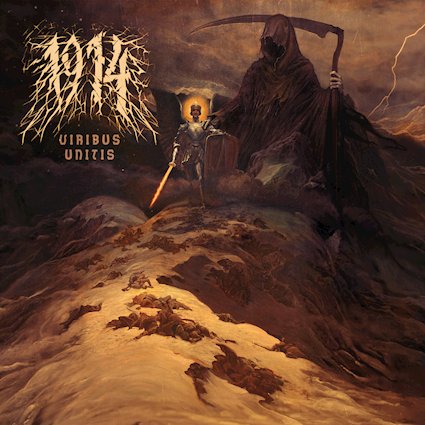 Continuing their warpath forged with the albums Eschatology of War (2015), The Blind Leading the Blind (2018), and Where Fear and Weapons Meet (2021), Ukrainian Blackened Death/Doom Metal formation 1914 returns with unrelenting force on their fourth studio album, Viribus Unitis, which is Latin for “With United Forces,” a phrase chosen as a personal motto by the Austro-Hungarian emperor Franz Joseph (1830-1916), reflecting the band’s resilience through war, loss, and upheaval, a powerful symbol of survival and solidarity. Recorded at Jenny Records, produced, mixed and mastered by Alexander Backlund and Tony Lindgren at Fascination Street Studios, and displaying another obscure artwork by Vladimir ‘Smerdulak’ Chebakov, the new opus by k.u.k. Galizisches IR Nr.15, Gefreiter, Ditmar Kumarberg on vocals, K.K. LIR Czernowitz Nr.22 Oberleutnant, Witaly Wyhovsky and K.K. LIR Stanislau Nr.20 Zugsführer, Oleksa Fisiuk on the guitars, k.u.k. Galizisch-Bukowina’sches IR Nr.24, Feldwebel, Armen Howhannisjan on bass, and K.K. LIR. Lemberg Nr.19 Fähnrich, Rostislaw Potoplacht on drums builds on the band’s acclaimed conceptual approach, pushing even deeper into emotional and musical intensity. Continuing their chronicle of World War I, 1914 shift their focus slightly, from the raw portrayal of death and destruction to themes of camaraderie, endurance, and the emotional landscapes of those who endured the horrors. Told through real events and personal accounts of a Ukrainian soldier in the K.u.K. army, the album traces a timeline from 1914 to 1919, painting a grim journey through the war’s rise, climax, and hollow aftermath.
War In (The Beginning of the Fall) is one of the band’s trademark intros we love so much, taking us to the horrors of war in 1914 (The Siege of Przemyśl), a lecture in Death and Doom Metal led by the demented drums by Potoplacht while Kumarberg roars and screams like a demonic war god. In other words, the album couldn’t have started on a more visceral, demolishing vibe, which is also the case in 1915 (Easter Battle for the Zwinin Ridge), where once again it’s fantastic how the excerpts, samples and songs from World War I added to their music always sound creepy, while the guitars by Wyhovsky and Fisiuk bring the heavy artillery to their already ruthless sonority. The bombs are coming strong in 1916 (The Südtirol Offensive), an explosive, scathing tune by 1914 where their incendiary riffs and blast beats bring sheer doom to our blackened hearts; and they keep hammering our cranial skulls with their Blackened Doom magic in 1917 (The Isonzo Front), led by the pounding drums by Potoplacht.
Then investing in a pure Doom Metal sound we face 1918 Pt 1: WIA (Wounded in Action), and the result is beyond haunting, heavy and grim, with Kumarberg’s deep vociferations sending shivers down our spines, followed by 1918 Pt 2: POW (Prisoner of War), with guest vocals by Christopher Scott of Precious Death, making an infernal duet with Kumarberg while the rumbling bass by Howhannisjan and the drums by Potoplacht sound like a true bombing squad. The third part of such an imposing aria, 1918 Pt 3: ADE (A Duty to Escape), features guest vocals by Aaron Stainthorpe of My Dying Bride and High Parasite, and when you have a guest like that you know you’re in for a treat of absolute Doom Metal madness, with the striking riffage by Wyhovsky and Fisiuk penetrating deep inside our skin; flowing into the very emotional and dark 1919 (The Home Where I Died), overflowing melancholy with the deep clean vocals by guest Jerome Reuter of Rome walking hand in hand with the song’s somber piano, before all comes to an end (or not) in War Out (The End?), as cryptic and obscure as usual, putting a stunning conclusion to the album.
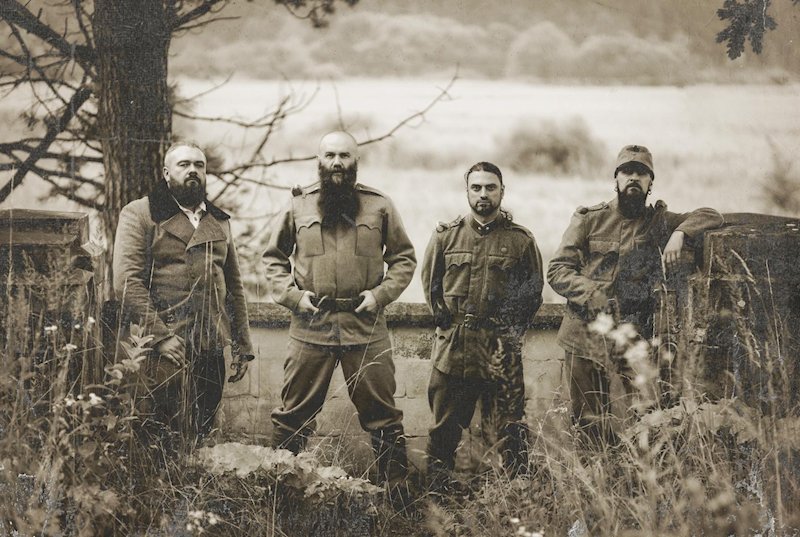 While their previous releases centered on the futility and finality of war, Viribus Unitis explores the human bonds forged under fire and the strength of those who returned, broken, changed, yet still alive, deepening their commitment to historical authenticity, both lyrically and conceptually. You can join 1914’s ranks on Facebook and on Instagram, staying up to date with their unparalleled live performances, subscribe to their YouTube channel, stream their warlike music on Spotify, and above all that, put your blood-soaked hands on Viribus Unitis by clicking HERE. In other words, trench warfare meets blackened death and doom in 1914’s fourth onslaught of war-torn fury, and you better get ready as those unstoppable Ukrainians want you to join them in the battlefield, for victory or death.
Best moments of the album: 1914 (The Siege of Przemyśl), 1916 (The Südtirol Offensive), 1918 Pt 1: WIA (Wounded in Action) and 1918 Pt 3: ADE (A Duty to Escape).
Worst moments of the album: None.
Released in 2025 Napalm Records
Track listing
1. War In (The Beginning of the Fall) 1:30
2. 1914 (The Siege of Przemyśl) 4:48
3. 1915 (Easter Battle for the Zwinin Ridge) 9:14
4. 1916 (The Südtirol Offensive) 6:11
5. 1917 (The Isonzo Front) 6:34
6. 1918 Pt 1: WIA (Wounded in Action) 6:20
7. 1918 Pt 2: POW (Prisoner of War) 6:12
8. 1918 Pt 3: ADE (A Duty to Escape) 5:50
9. 1919 (The Home Where I Died) 7:07
10. War Out (The End?) 3:10
3-LP Gatefold Vinyl Marbled Cristallo/Gold/Deluxe Wooden Box Bonus Vinyl/Welcome to the Trench Club EP
1. War In 1:07
2. Die Karpathenschlacht (Rework 2025) 6:02
3. Die Karpathenschlacht (Ship Her Son RMX) 4:30
4. 8 × 50 mm R. Infanterie Repetiergewehr M.95 (Rework 2025) 7:29
5. 8 × 50 mm R. Infanterie Repetiergewehr M.95 (Kadaitcha RMX) 6:55
6. War Out 1:33
Band members
k.u.k. Galizisches IR Nr.15, Gefreiter, Ditmar Kumarberg – vocals
K.K. LIR Czernowitz Nr.22 Oberleutnant, Witaly Wyhovsky – guitar
K.K. LIR Stanislau Nr.20 Zugsführer, Oleksa Fisiuk – guitar
k.u.k. Galizisch-Bukowina’sches IR Nr.24, Feldwebel, Armen Howhannisjan – bass
K.K. LIR. Lemberg Nr.19 Fähnrich, Rostislaw Potoplacht – drums
Guest musicians
Christopher Scott – vocals on “1918 Pt 2: POW (Prisoner of War)”
Aaron Stainthorpe – vocals on “1918 Pt 3: ADE (A Duty to Escape)”
Jerome Reuter – vocals on “1919 (The Home Where I Died)”
 THE HEADBANGING MOOSE