Trench warfare meets blackened death and doom in 1914’s fourth onslaught of war-torn fury, tracing a timeline from 1914 to 1919 while painting a grim journey through the war’s rise, climax, and hollow aftermath.
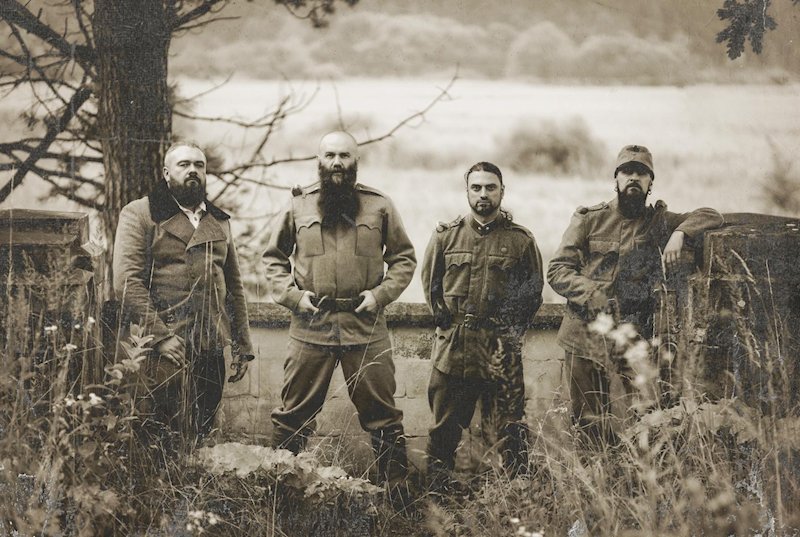
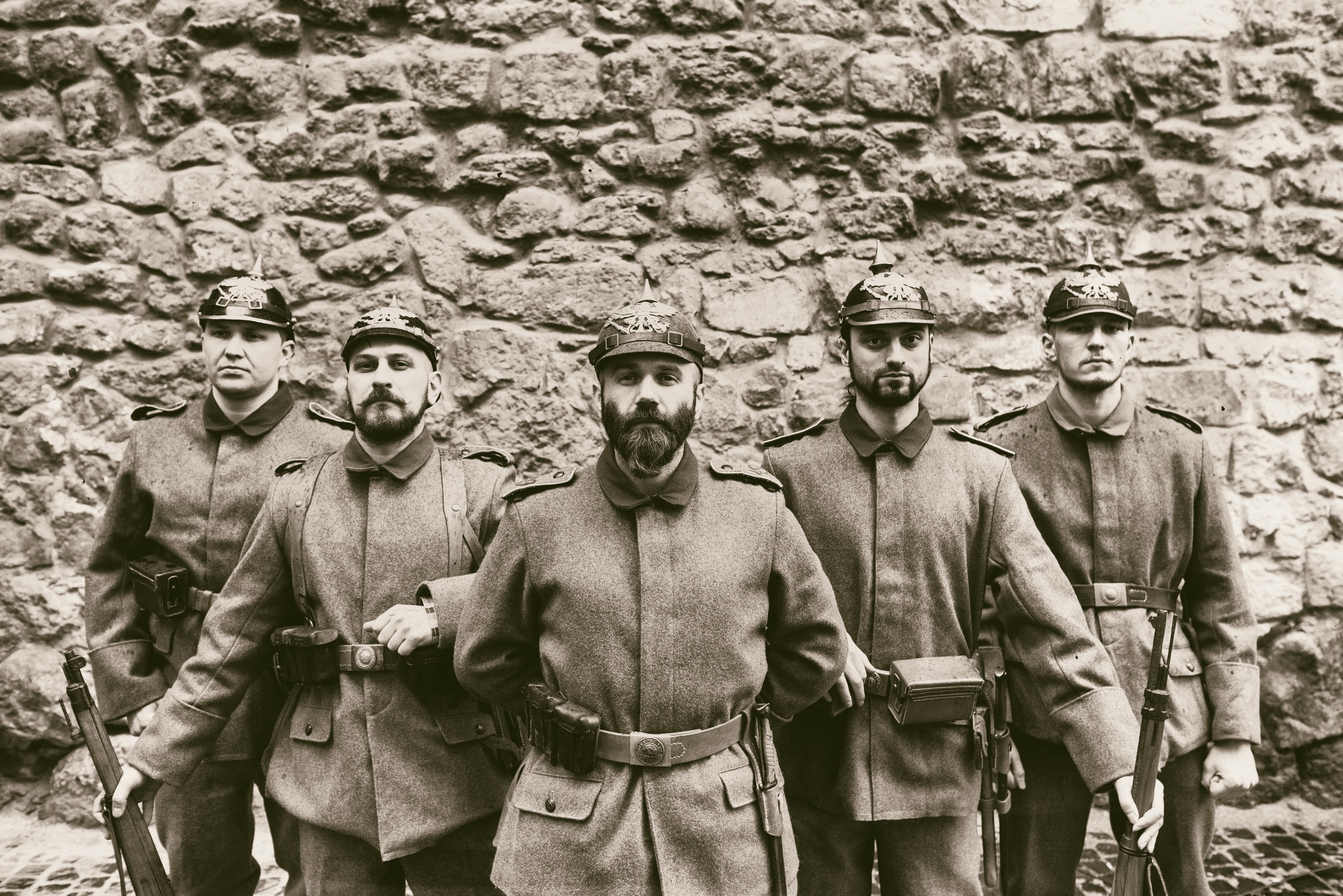
Continuing their warpath forged with the albums Eschatology of War (2015), The Blind Leading the Blind (2018), and Where Fear and Weapons Meet (2021), Ukrainian Blackened Death/Doom Metal formation 1914 returns with unrelenting force on their fourth studio album, Viribus Unitis, which is Latin for “With United Forces,” a phrase chosen as a personal motto by the Austro-Hungarian emperor Franz Joseph (1830-1916), reflecting the band’s resilience through war, loss, and upheaval, a powerful symbol of survival and solidarity. Recorded at Jenny Records, produced, mixed and mastered by Alexander Backlund and Tony Lindgren at Fascination Street Studios, and displaying another obscure artwork by Vladimir ‘Smerdulak’ Chebakov, the new opus by k.u.k. Galizisches IR Nr.15, Gefreiter, Ditmar Kumarberg on vocals, K.K. LIR Czernowitz Nr.22 Oberleutnant, Witaly Wyhovsky and K.K. LIR Stanislau Nr.20 Zugsführer, Oleksa Fisiuk on the guitars, k.u.k. Galizisch-Bukowina’sches IR Nr.24, Feldwebel, Armen Howhannisjan on bass, and K.K. LIR. Lemberg Nr.19 Fähnrich, Rostislaw Potoplacht on drums builds on the band’s acclaimed conceptual approach, pushing even deeper into emotional and musical intensity. Continuing their chronicle of World War I, 1914 shift their focus slightly, from the raw portrayal of death and destruction to themes of camaraderie, endurance, and the emotional landscapes of those who endured the horrors. Told through real events and personal accounts of a Ukrainian soldier in the K.u.K. army, the album traces a timeline from 1914 to 1919, painting a grim journey through the war’s rise, climax, and hollow aftermath.
War In (The Beginning of the Fall) is one of the band’s trademark intros we love so much, taking us to the horrors of war in 1914 (The Siege of Przemyśl), a lecture in Death and Doom Metal led by the demented drums by Potoplacht while Kumarberg roars and screams like a demonic war god. In other words, the album couldn’t have started on a more visceral, demolishing vibe, which is also the case in 1915 (Easter Battle for the Zwinin Ridge), where once again it’s fantastic how the excerpts, samples and songs from World War I added to their music always sound creepy, while the guitars by Wyhovsky and Fisiuk bring the heavy artillery to their already ruthless sonority. The bombs are coming strong in 1916 (The Südtirol Offensive), an explosive, scathing tune by 1914 where their incendiary riffs and blast beats bring sheer doom to our blackened hearts; and they keep hammering our cranial skulls with their Blackened Doom magic in 1917 (The Isonzo Front), led by the pounding drums by Potoplacht.
Then investing in a pure Doom Metal sound we face 1918 Pt 1: WIA (Wounded in Action), and the result is beyond haunting, heavy and grim, with Kumarberg’s deep vociferations sending shivers down our spines, followed by 1918 Pt 2: POW (Prisoner of War), with guest vocals by Christopher Scott of Precious Death, making an infernal duet with Kumarberg while the rumbling bass by Howhannisjan and the drums by Potoplacht sound like a true bombing squad. The third part of such an imposing aria, 1918 Pt 3: ADE (A Duty to Escape), features guest vocals by Aaron Stainthorpe of My Dying Bride and High Parasite, and when you have a guest like that you know you’re in for a treat of absolute Doom Metal madness, with the striking riffage by Wyhovsky and Fisiuk penetrating deep inside our skin; flowing into the very emotional and dark 1919 (The Home Where I Died), overflowing melancholy with the deep clean vocals by guest Jerome Reuter of Rome walking hand in hand with the song’s somber piano, before all comes to an end (or not) in War Out (The End?), as cryptic and obscure as usual, putting a stunning conclusion to the album.
While their previous releases centered on the futility and finality of war, Viribus Unitis explores the human bonds forged under fire and the strength of those who returned, broken, changed, yet still alive, deepening their commitment to historical authenticity, both lyrically and conceptually. You can join 1914’s ranks on Facebook and on Instagram, staying up to date with their unparalleled live performances, subscribe to their YouTube channel, stream their warlike music on Spotify, and above all that, put your blood-soaked hands on Viribus Unitis by clicking HERE. In other words, trench warfare meets blackened death and doom in 1914’s fourth onslaught of war-torn fury, and you better get ready as those unstoppable Ukrainians want you to join them in the battlefield, for victory or death.
Best moments of the album:1914 (The Siege of Przemyśl), 1916 (The Südtirol Offensive), 1918 Pt 1: WIA (Wounded in Action) and 1918 Pt 3: ADE (A Duty to Escape).
Worst moments of the album: None.
Released in 2025 Napalm Records
Track listing 1. War In (The Beginning of the Fall) 1:30
2. 1914 (The Siege of Przemyśl) 4:48
3. 1915 (Easter Battle for the Zwinin Ridge) 9:14
4. 1916 (The Südtirol Offensive) 6:11
5. 1917 (The Isonzo Front) 6:34
6. 1918 Pt 1: WIA (Wounded in Action) 6:20
7. 1918 Pt 2: POW (Prisoner of War) 6:12
8. 1918 Pt 3: ADE (A Duty to Escape) 5:50
9. 1919 (The Home Where I Died) 7:07
10. War Out (The End?) 3:10
3-LP Gatefold Vinyl Marbled Cristallo/Gold/Deluxe Wooden Box Bonus Vinyl/Welcome to the Trench Club EP
1. War In 1:07
2. Die Karpathenschlacht (Rework 2025) 6:02
3. Die Karpathenschlacht (Ship Her Son RMX) 4:30
4. 8 × 50 mm R. Infanterie Repetiergewehr M.95 (Rework 2025) 7:29
5. 8 × 50 mm R. Infanterie Repetiergewehr M.95 (Kadaitcha RMX) 6:55
6. War Out 1:33
Guest musicians
Christopher Scott – vocals on “1918 Pt 2: POW (Prisoner of War)”
Aaron Stainthorpe – vocals on “1918 Pt 3: ADE (A Duty to Escape)”
Jerome Reuter – vocals on “1919 (The Home Where I Died)”
As The Headbanging Moose is celebrating nine years of existence this month of October, there’s nothing better than offering the first slice of our cake to a woman who’s undoubtedly the most important name of all time from the Ukrainian rock and metal scene, and I would dare to say even from the entire music scene in Ukraine. Born on March 15, 1987 in Horlivka, or Gorlovka, a city located in Donetsk Oblast, Ukraine, she’s a singer and songwriter better known as the frontwoman for Groove Metal/Metalcore act Jinjer since 2010, kicking some serious ass wherever she goes armed with both her furious roars and mesmerizing clean vocals. I’m talking about the one and only Tatiana Shmayluk, a multi-talented and humble woman who’s also a role model to countless girls out there who want to find in heavy music a way to express all of their feelings, hopes and frustrations, and I’m sure you’ll get addicted to her vocals and her music after reading this tribute to her.
Long before becoming the face of Jinjer, Tatiana was already singing and screaming according to her own mother, always listening to Russian and Ukrainian pop songs she heard on the radio. “My mother told me I started screaming when I was a very little girl. I screamed so loud I had a hernia in my belly.” Furthermore, one of her favorite songs from her childhood was the 1989 dance song Lambada, by French-Brazilian group Kaoma, which she mentioned she still sings along to it with great joy, although she doesn’t know Portuguese. She then began singing more seriously at the age of eight, taking vocal lessons for a couple of months and making her onstage debut that year in a concert hall with a choir. “The songs were accompanied with dancing. I was very nervous, and of course I screwed it up because of the dancing. So I said, ‘Never again.’ I cannot do synchronic dancing with someone else. I need to do it alone so I can control the whole thing,” commented Tatiana, who also said that it was her older brother, who was a guitar player to a Doom Metal band, who introduced her to metal music, more specifically to Aria, the long-running Moscow metal outfit hailed as the “Iron Maiden of Russia.”
Proudly carrying the flag of modern-day metal music to all four corner of the earth, Jinjer were formed back in 2008 in Donetsk, but the band considers their official start with the addition of Tatiana and guitarist Roman Ibramkhalilov in 2010. None of the founding members remain with the band, with the current lineup being comprised of the aforementioned Tatiana on vocals and Roman on the guitars, together with Eugene Abdukhanov on bass and Vladislav Ulasevish on drums. Influenced by countless renewned acts the likes of Opeth, Guano Apes, Slayer, Death, Pantera, Anathema, Lamb of God, Gojira and Twelve Foot Ninja, as well as groups across the spectrum of R&B, soul, funk, jazz, reggae, and hip-hop, such as Cypress Hill and House of Pain, the band has already released four studio albums in their career, those being their 2014 debut Cloud Factory, their 2016 sophomore album King of Everything, and more recently their 2019 opus Macro and their 2021 critically acclaimed album Wallflowers, all of which have reached number one in their native Ukraine, while also seeing a total of 16 singles, six of which reached the top of the Ukrainian charts and one of which, Pisces, became a global hit and has to date sold over 20 million copies. In addition, they’ve also released three EP’s, those being Objects in Mirror Are Closer Than They Appear (2009), Inhale, Do Not Breathe (2012) and Micro (2019), and the 2020 live album Alive in Melbourne. You can enjoy several of their best compositions on YouTube, such as Vortex, Judgement (& Punishment), Wallflower, Home Back, Sit Stay Roll Over, and Who Is Gonna Be The One, as well as their full ass-kicking performance live at Resurrection Fest in Viveiro, Spain, in 2018, among many, many other awesome videos, and don’t forget to also stream their full discography on Spotify.
Unfortunately, not long after the ongoing conflict between the Ukrainian military, anti-government protestors and pro-Russian rebels began in 2014, Tatiana and her bandmates had to escape Donetsk, moving to a suburb near the city of Lviv around 800 miles away, not far from the Polish border. “”But we got bored there because it’s a city for tourists,” explained Tatiana. “We rented a house but it was impossible to live there because there were problems with water, with electricity, heating. So that’s why we moved to a more civilized place.” Furthermore, when asked about what makes Jinjer uniquely Ukrainian, she said that because the band comes from a land where kindness equals weakness, a tough country for everyone including their parents, especially in the 90’s, the band members became really grind and tough. For instance, she mentioned that Ukrainians don’t go to a doctor if something hurts, for example, enduring the pain until the end. That’s one of the reasons why the band tries to never cancel any of their concerts and tours, even if it’s impossible to play, showing how strong and determined they are.
Apart from her undisputed career with Jinjer, you can also find Tatiana as a guest vocalist in an array of distinct albums and songs, including the songs Through the Never (I Will Return) and Horror of Daniel Wagner, from the 2022 album Horror of Daniel Wagner, by Ukrainian Heavy/Power Metal band Morton; the song Find My Way, released in 2022 by American Modern Metal band Lions At The Gate; the song Over and Out, released in 2021 by Australian Heavy Rock band Twelve Foot Ninja; and my favorite of all those tracks, the pulverizing Hello Death, from the 2022 album Cancer Culture, released by Polish Death/Groove Metal act Decapitated. Not only that, if you pay good attention to Jinjer’s song Judgment (& Punishment) you’ll notice several elements from reggae added to the band’s extreme music, and that’s something that comes from Tatiana as she was a part of a band that played reggae, ska, ska-punk and funk before Jinjer, playing several cover songs and singing in Ukrainian, Russian and English. “I was a huge fan of reggae. I wore dreadlocks and I was all about Rastafari,” commented Tatiana, who also said that, even being a huge reggae fan, she doesn’t smoke weed simply because she doesn’t like it.
Currently living in Los Angeles, California and spending as much time as possible on tour, having closed 2021 with over 70 concerts including many summer festivals, a short tour of mainland Europe and a two-month North American tour, Tatiana obviously misses her homeland, her family and friends, although she finds the region’s lingering Soviet attitudes unappealing, with the remnants of hardline communism surrounding everyone there. While she was still living in Ukraine, she said that “I was too young to remember life in Soviet Union, but the spirit of Soviet Union is still here. I’m living in an apartment built maybe 40 years ago, and my parents live in such an apartment, as well. All our shops and supermarkets are situated in buildings built then. So it is still like Soviet Union. And there are a lot of people who still have Soviet Union in their heads and their minds.” However, Tatiana mentioned she doesn’t feel safe when on tour it doesn’t matter which country she’s visiting, not only in Ukraine, saying she’s always afraid of going anywhere by herself.
In one of her interviews, Tatiana said it’s a surprise to her that people are still impressed that women can scream, mentioning for example female-fronted German thrash metallers Holy Moses, who she got to know when she was an 18-year old girl in Ukraine, and saying that despite the fact bands like Jinjer might impress the younger generations, the older generations have always known what women can do in rock and metal music. “Sometimes I’m annoyed, but then you say, ‘OK, well, I didn’t see a hummingbird until I was 35 years old.’ It’s always a right time to discover new stuff. It’s great that screaming women are a phenomenon.” She also said it’s incredible to know she’s an inspiration for many young women mainly because they don’t know she’s in fact a very shy person, also sensitive, fragile and easy to be offended, or in her own words, she’s not better than anyone, complementing by saying she’s just a performer when she’s on stage. “Of course there is some true shit, but I don’t move my head 24/7 and I don’t scream all the time. Well, I scream every night. But not every morning.” Furthermore, you can learn a little more about how Tatiana learned to scream by clicking HERE, from first hearing Otep to screaming Mudvayne lyrics, to the dominant force she is today.
This slideshow requires JavaScript.
As any other metalhead in the world, Tatiana has a lot of idols and influences in her life, in her vocal style, in the way she writes the music for Jinjer and so on, but following those artists wasn’t easy at all when she was a young girl due to the aforementioned impact of the Soviet Union over Ukraine at that time. “Metal wasn’t accessible for me. Where I grew up in Donetsk, not many worldwide metal artists would come. They’d go to the capital, and it was 700km and 12 hours on the train. I didn’t have money because I was a teenager and my mom was strict; she didn’t give me much pocket money, although that stimulated me to earn it myself, for which I’m really grateful to her. My parents wouldn’t have let me out of the town, but that was for the best too. It made me want to play my own music and form my own band.” As mentioned, her brother was the one who got her into metal (although he stopped listening to heavy music when he grew up), but before that she used to listen to a lot of rock music, grunge and punk especially after the Soviet Union collapsing in 1991, as MTV hit the Ukrainian airwaves and she began listening to bands like Nirvana and The Offspring. She then found the music by Otep, and got addicted to the vocals by the iconic Otep Shamaya. “I think I was 15 when I heard Otep the first time,” said Tatiana in one of her interviews. “I said, ‘This dude is so cool!’ And my friend said, ‘This is a girl!’ I was like, ‘Jesus fucking Christ!’ This is the first girl I am hearing do this. I was shocked, and I wanted to shock people like her.”
Being a rock and metal artist in Ukraine wasn’t easy at all, taking Tatiana and the rest of the band around five years just to cross the Ukrainian border and play in Romania, and even longer to reach other European countries and the United States, but fortunately everything seems to be working for Jinjer now, with the band organically growing in the worldwide scene and gaining more and more respect from fans from all four corners of the earth. As expected, Tatiana has some important complaints about the Ukrainian metal scene, saying that most Ukrainian bands stick to playing in Ukraine or Russia, and that they don’t usually sing in English, the main reason why they just play in their motherland. “I was always inspired by western music culture in jazz, blues and then metal. I always had this love for English speaking music, even pop music; Britney Spears is one of my biggest idols! People can understand it easily and for me, it was always about spreading my own message through a language that is more available for people all around the world of different countries. That’s why we chose to sing in English and that’s how we made our own path.” Another major issue in Ukraine according to her is the post-U.S.S.R. thinking and mindset, where you’re not accepted if you’re different, as for example tattoos (and we all know she has plenty) are not acceptable for men nor women in her homeland.
However, as you might probably know, Ukraine is suffering with the Russian invasion that started back in February this year, and that has been hitting the band hard in their hearts and minds since then. In March 2022, it was reported that Jinjer had “paused” their career to focus on relief efforts in Ukraine after the war began. Right after that, in June 2022, Jinjer announced that they received permission from the Ukrainian Ministry of Culture to leave Ukraine and tour as ambassadors of the nation to raise funds and awareness. “We are very thankful to our Ministry Of Culture for the Ukraine who gave us this opportunity to do what we love to do, and play all the festivals we have announced. We’re using every festival to raise funds and spread awareness about the real war that is happening in the 21st century, which is crazy. It’s hard to believe, but this is the harsh reality. It’s heartbreaking, but at the same time we are also full of hope that soon it is all going be over. We are spreading positivity and hope, and we are dreaming about peace. I hope that no other European or world country ever experiences the same as the Ukraine,” commented Tatiana, also saying she has no idea when Jinjer will be able to play in Ukraine again, and that the band will never stop fighting. Moreover, in their most recent releases there are lyrics addressing the war in Donbas and its effects on their home region of Donetsk, and you can also find tons of amazing interviews with Tatiana and the boys talking about the war in Ukraine, just like this one conducted by Loudwire.
Regarding her relationship with social media, Tatiana said that due to her explosive nature she usually replies back to anyone that messages her, it doesn’t matter if it’s a positive or negative comment, saying she “enjoys” replying back to internet trolls because she’s easy to piss off. “Sometimes it’s just overwhelming. I feel like if I let it go, I will let them continue to do this shit again and again. It’s like I give them unspoken permission,” commented our stunning diva, also saying most of the feedback she gets online is actually positive. In addition, one of her favorite ways of interacting with her fans is to customize shirts she receives from them before a show and wear them onstage the same night. “Most of the time, these shirts are very personal. For example, yesterday I was given a shirt — it has a huge ape giving a middle finger and it says something like, ‘Humans destroy everything.’ It’s so related to our song Ape. They will see me wear it on the stage and it is a huge pleaser. They get double joy. I love all the things they bring to me at meet and greet. They are so sweet,” said Tatiana, complementing by saying that some of those fans are very shy and don’t want to talk a lot, being very happy with just an autograph and a photo.
Our unstoppable frontwoman also said that, in an effort to improve her own standing with Mother Nature, she tried to be a vegan for three years, but she went back to eating meat in the middle of a tour because she was starving. She said she still tries to be moderate in consuming meat, and that she doesn’t drink milk, though, revealing her own inner conflict. “I still try being vegan, but it’s really hard for me because I was raised in a family that was not very rich,” she explained. “We could not afford eating meat very often. So when I stopped eating meat, I realized that I loved meat a lot. When I smell meat, it drives me crazy. Something inside of me forgets about animals, suffering, health, environment, and I just want a good piece of meat.” You can get to know more about Tatiana by listening to our growler answering 10 questions asked by Metalshop TV (volume 1 and volume 2), as well as other interviews online such as Tatiana and her bandmates answering the most asked questions on the Internet about Jinjer. Lastly, just like several people out there (including myself), Tatiana also believes something went wrong in our evolution, saying mankind went wrong, and that although we are so small on this earth we act like we are gods, which makes her really sad. She’s trying to learn how to be happy, how to find the happiness inside, and to appreciate her life. “That’s my biggest ambition, to be happy and find inner peace, and for there to be justice for Ukraine.”
“You know what, I’m losing my faith in music. I don’t feel like I can express myself enough to say what I really feel because there are no words to explain. So, I feel like I should give up… but then something makes me go further.” – Tatiana Shmayluk
Ukraine’s own doom infantry is back into the battlefield with another masterpiece, telling the gruesome tales of World War I, its soldiers’ fate, their death, fear and feats to be never forgotten.
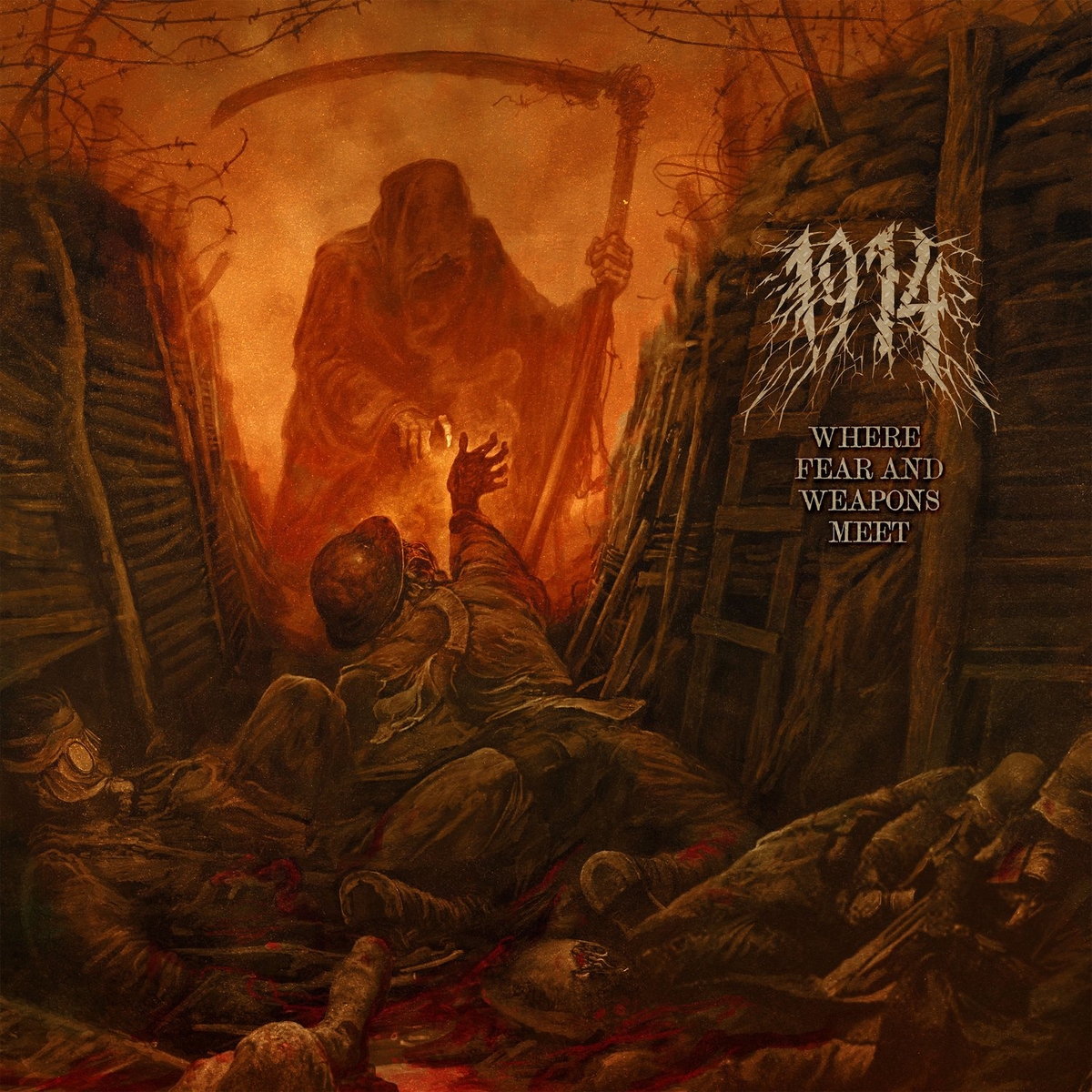
Lviv, Ukraine-based Blackened Death/Doom Metal offensive 1914 continues to reflect the gruesome tales of World War I, its soldiers’ fate, their death, fear and feats to be never forgotten, unleashing upon humanity their superb new opus entitled Where Fear and Weapons Meet, comprised of eleven tracks of pure historic harshness following up to the band’s sophomore album The Blind Leading the Blind and their debut effort Eschatology of War. Unlike their previous works, Where Fear and Weapons Meet is not about death, but about life, as most of the heroes and protagonists in the songs survived war, became heroes and finally returned home, with even the album cover emphasizing this by depicting an injured, shell-shocked and bleeding sole survivor of a shield attack holding his hand out to death, praying in agony, but death does not take him away. Furthermore, the album begins in Serbia and continues on the first track from the prospective of Gavrilo Princip, who assassinated Austrian Archduke Franz Ferdinand and his wife on June 28, 1914 in Sarajevo and caused the outbreak of World War I, all masterfully embraced by the massive fusion of sludge, death and doom sounds crafted by vocalist Ditmar Kumarberg, guitarists Liam Fessen and Vitalis Winkelhock, bassist Armin von Heinessen and drummer Rusty Potoplacht.
As expected the band kicks things off with their trademark intro War In, this time showcasing the original of the most famous Serbian song of the Great War period, “Tamo Daleko”, setting the stage for 1914 to crush our senses with FN .380 ACP#19074, with Rusty sounding infernal and ruthless on drums while Liam and Vitalis deliver endless electricity and heaviness through their wicked riffage. What a bestial start to the album, I might say, followed by Vimy Ridge (In Memory of Filip Konowal), offering us all another round of their WWI-inspired doomed lyrics growled by Ditmar (“Things didn’t go down as expected / Hill 145, ill-fated Vimy Ridge. / We are entrenched in mud as wild hogs, my 47th Battalion / A small wooded knoll we called “the Pimple” 2 miles in front of us. / We need to capture the machine gun nests, each was heavily defended”) in a demonic display of Ukrainian Sludge, Death and Doom Metal. Pillars of Fire (The Battle of Messines) describes the terrible events of the Battle of the Messines Ridge during June 7-14, 1917 in Belgium, one of the most insane episodes of the Great War, while musically speaking you better get ready for another multi-layered wall of sounds spearheaded by Rusty’s venomous blast beats and all the symphonic, cinematic background sounds; and continuing their path of doom and devastation we face Don’t Tread on Me (Harlem Hellfighters), where the sound of the guitars by Liam and Vitalis is phenomenal, not to mention the thunderous bass by Armin, whereas featuring Ukrainian country and folk musician, singer and songwriter Sasha Boole, Coward is very unique and distinct form the rest of the album, with the final result being really entertaining.
…And a Cross Now Marks His Place brings forward an amazing and brutal vocal duet between Ditmar and guest Nick Holmes (Paradise Lost), resulting in a lecture in old school Doom Metal that will inspire you to crack your neck headbanging, followed by Corps d’autos-canons-mitrailleuses (A.C.M), where a wicked intro quickly morphs into a Blackened Doom feast showcasing the band’s trademark warlike words (“Hold the line, Minerva will cover us / The Hotchkiss machine gun poured lead in all directions / Send our messages to all boches – We will avenge for the Belgium! / 16 of us were killed in action, / 16 of us in this Galizian sludge / They called home”). In Mit Gott für König und Vaterland we’re treated to five minutes of obscurity, brutality and fear in the form of ass-kicking Doom and Death Metal led by the demented growls by Ditmar; whereas the sound of bagpipes will penetrate deep inside your mind before 1914 come crushing like a war tank in their version for Eric Bogle’s The Green Fields of France (No Man’s Land), which original version can be appreciated HERE, an impressive rendition where Liam and Vitalis are on absolute fire with their unstoppable riffs, not to mention the song’s demonic, hellish ending, flowing into War Out, putting a climatic and stylish conclusion to their sonic battle.
It’s time to head into the battlefield together with the unstoppable troopers of 1914, and in order to do so you can enjoy the album in full on YouTube and on Spotify, follow the band on Facebook and on Instagram for tour dates and other nice-to-know information about them, subscribe to their YouTube channel for more of their austere music, and above all that, purchase your favorite version of the stunning Where Fear and Weapons Meet by clicking HERE. This masterpiece is indeed another heavily intense and deep-reaching output that will grant 1914 even higher appreciation than the five-piece is already credited with, and I must say that after such powerful and bold album the band has gone beyond the underground barrier and can now be considered one of the torchbearers of warlike doom worldwide. In other words, the Great War lives on, mainly thanks to the brilliant job done by the best Ukrainian metal band of all time.
Best moments of the album: Vimy Ridge (In Memory of Filip Konowal), Pillars of Fire (The Battle of Messines), …And a Cross Now Marks His Place and The Green Fields of France (No Man’s Land, Eric Bogle cover).
Worst moments of the album: Absolutely none.
Released in 2021 Napalm Records
Track listing 1. War In 1:11
2. FN .380 ACP#19074 5:54
3. Vimy Ridge (In Memory of Filip Konowal) 5:11
4. Pillars of Fire (The Battle of Messines) 7:04
5. Don’t Tread on Me (Harlem Hellfighters) 7:54
6. Coward (ft. Sasha Boole) 2:55
7. …And a Cross Now Marks His Place (ft. Nick Holmes) 7:29
8. Corps d’autos-canons-mitrailleuses (A.C.M) 7:54
9. Mit Gott für König und Vaterland 5:18
10. The Green Fields of France (No Man’s Land, Eric Bogle cover) 10:57
11. War Out 1:40
It’s time to head into the battlefields of the Great War together with these talented and obstinate Blackened Death and Doom Metal infantrymen from Ukraine.
It’s time to head into the battlefields of World War I together with Ukranian Blackened Death/Doom Metal infantrymen 1914 and their brand new opus, the breathtaking The Blind Leading the Blind. World World I might not get explored as it should very often, as World War II typically overshadows it, but this Liviv-based squad, formed in 2014 at the 100th anniversary of World War I, makes a damn solid case for its historical significance (click HERE for an in-depth interview regarding the band’s ideology), with their unique and incendiary fusion of Black, Death, Doom and even Sludge Metal being stomping, heavy-as-hell, therefore inspiring the strength and bravery within to march towards death.
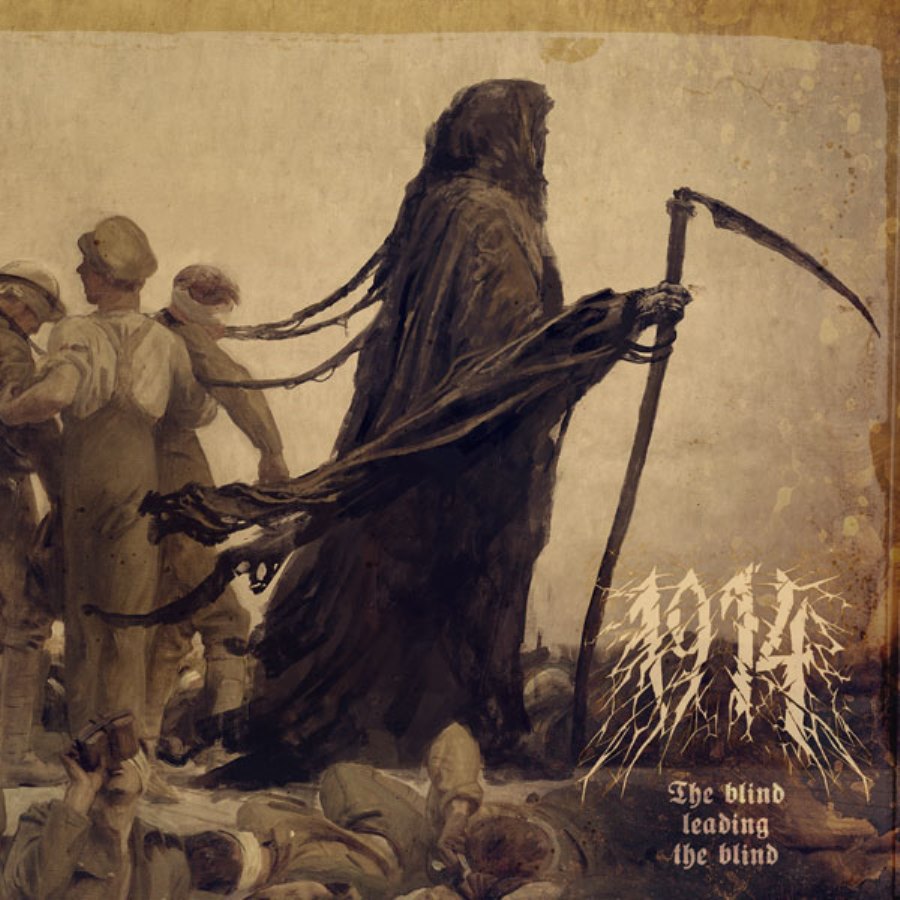
Comprised of 2.Division, Infanterie-Regiment Nr.147, Oberleutnant – Ditmar Kumar on vocals, 37.Division, Feldartillerie-Regiment Nr.73, Wachtmiester – Liam Fessen and 5.Division, Ulanen-Regiment Nr.3, Sergeanten – Vitalis Winkelhock on the guitars, 9.Division, Grenadier-Regiment Nr.7, Unteroffiziere – Armin von Heinessen on bass and 33.Division, 7.Thueringisches Infanterie-Regiment Nr.96, Gefreite – Rusty Potoplacht on drums, 1914 pay homage to all that fell fighting the Great War, with their themes covering topics such as the Battle of Gallipoli (and the involvement of Ataturk), the Brusilovsky breakthrough, the Battle of Verdun and the gas attack at Ypres, not being political nor warmongers, but just telling the tales of war, injustice, fear, hopelessness and endless death as they happened. Featuring a deadly, lugubrious artwork by Czech artist Vladimir “Smerdulak” Chebakov, The Blind Leading the Blind is a precious gem of extreme music, positioning 1914 not only as one of the best underground metal bands of the current scene, but of the past decade without a shadow of a doubt.
War In is a beautiful, wicked and dark intro that takes us to the horrors of World War I, exploding into visceral Blackened Death Metal in Arrival. The Meuse-Argonne (inspired by the Meuse-Argonne Offensive, the greatest American battle of the First World War, where in six weeks the AEF lost 26,277 killed and 95,786 wounded), led by the pulverizing drums by Rusty, while Ditmar roars the song’s lyrics manically (“Arrival / The Meuse-Argonne offensive started like clockwork / We planned to break through the Hindenburg line / I know what we are fighting for / Hopefully to end the war”), also bringing the most Stygian elements from classic Doom Metal. Then we have A7V Mephisto, a World War I German tank masterfully translated into a brutal and heavy tune where the entire band showcases their heavy artillery by blasting sheer obscurity inspired by old school Black Sabbath and Celtic Frost, in special Liam and Vitalis with their lethal riffs, but with a more demonic twist; followed by High Wood. 75 Acres of Hell, an infernal display of Black and Death Metal spearheaded by Ditmar’s growls while Armin and Rusty keep the ambience as dense and grim as possible with their respective instruments, displaying the battle for High Wood’s 75 acres, which started on July 14 and raged nearly continuously for 64 days, coming to be known as “The hell of High Wood” or “The rottenest place on the Western Front.”
Bagpipes ignite a sinister and pulverizing cover version for The Exploited’s all-time hit Beat The Bastards, sounding as rebellious and fun as the original version, but of course with a more metallic and crushing vibe, with highlights to the beautiful job done by both Liam and Vitalis with their hellish guitars. In the interesting bridge Hanging On The Barbed Wire, the infantry sings while marching under a heavy storm (“If you want to find the General, / I know where he is, / If you want to find the General, / I know where he is / He’s pinning another medal on his chest / I saw him, I saw him / Pinning another medal on his chest.”), setting the tone for the superb Passchenhell, a wordplay with The Battle of Passchendaele, also known as the Third Battle of Ypres, a campaign of World War I fought by the Allies against the German Empire. Musically speaking, it’s another flawless display of Blackened Death Metal infused with Doom Metal nuances, also featuring the beyond special guest vocalist David Ingram (Benediction, Bolt Thrower, Just Before Dawn). Furthermore, Rusty is once again bestial on drums, whereas Ditmar together with David will haunt your soul with their demonic growling.
“Hello there, soldier! Ready to kill more Germans?” Those warlike words ignite a fantastic sonic havoc by 1914 titled C’est Mon Dernier Pigeon, leaning towards pure old school Black Metal, feeling and sounding as thunderous and menacing as possible and ending in the most demolishing way you can think of; followed by Stoßtrupp, the German word used to describe shock troops or assault troops created to lead an attack, where another eerie, obscure narration suddenly explodes into a darkened feast of Black and Death Metal tailored for cracking your neck headbanging, with Armin sounding vicious with his rumbling bass punches. Lastly, we have The Hundred Days Offensive, an Allied offensive that lasted from August 8 to November 11, 1918, ending World War I, and 1914 turned that battle into 10 minutes of first-class Blackened Death and Doom Metal where you can feel the horrors of the battlefield in the music, remaining very introspective, melancholic, and flowing infernally until the music morphs into the sensational and creepy outro War Out, the perfect ending to such brilliant album.
In summary, The Blind Leading the Blind, which by the way had as its official release date the 11th hour on the 11th day of the 11th month (Central European Time), marking the 100th anniversary of the end of World War I, is a must-have not only for admirers of Extreme Metal, but also for anyone who wants to learn more about World War I in a very unorthodox and exciting way. Available for purchase from the band’s own BandCamp page, as well as from the Archaic Sounds’ BandCamp page, from the Redifining Darkness Records’ BandCamp page, from iTunes and from Discogs, The Blind Leading the Blind definitely redefines the career of 1914, propelling them into a more-than-promising future. Having said that, don’t forget to follow them on Facebook, subscribe to their YouTube channel, grab your weapons and be prepared to face death in the battlegrounds of the Great War.
Best moments of the album:Arrival. The Meuse-Argonne, Beat The Bastards, Passchenhell and C’est Mon Dernier Pigeon.
Worst moments of the album: None.
Released in 2018 Archaic Sound/Redefining Darkness Records
Track listing 1. War In 1:14
2. Arrival. The Meuse-Argonne 6:20
3. A7V Mephisto 8:13
4. High Wood. 75 Acres of Hell 5:27
5. Beat The Bastards (The Exploited cover) 5:02
6. Hanging On The Barbed Wire 2:28
7. Passchenhell (feat. David Ingram) 7:01
8. C’est Mon Dernier Pigeon 5:22
9. Stoßtrupp 6:13
10. The Hundred Days Offensive 10:01
11. War Out 1:55
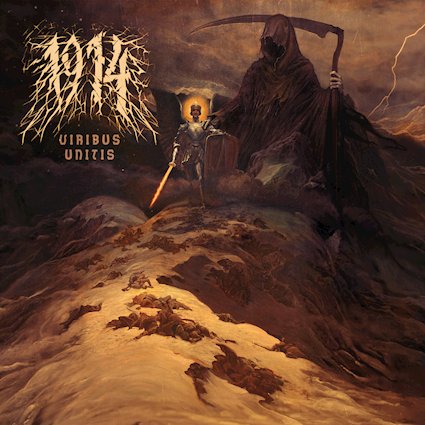 Continuing their warpath forged with the albums Eschatology of War (2015), The Blind Leading the Blind (2018), and Where Fear and Weapons Meet (2021), Ukrainian Blackened Death/Doom Metal formation 1914 returns with unrelenting force on their fourth studio album, Viribus Unitis, which is Latin for “With United Forces,” a phrase chosen as a personal motto by the Austro-Hungarian emperor Franz Joseph (1830-1916), reflecting the band’s resilience through war, loss, and upheaval, a powerful symbol of survival and solidarity. Recorded at Jenny Records, produced, mixed and mastered by Alexander Backlund and Tony Lindgren at Fascination Street Studios, and displaying another obscure artwork by Vladimir ‘Smerdulak’ Chebakov, the new opus by k.u.k. Galizisches IR Nr.15, Gefreiter, Ditmar Kumarberg on vocals, K.K. LIR Czernowitz Nr.22 Oberleutnant, Witaly Wyhovsky and K.K. LIR Stanislau Nr.20 Zugsführer, Oleksa Fisiuk on the guitars, k.u.k. Galizisch-Bukowina’sches IR Nr.24, Feldwebel, Armen Howhannisjan on bass, and K.K. LIR. Lemberg Nr.19 Fähnrich, Rostislaw Potoplacht on drums builds on the band’s acclaimed conceptual approach, pushing even deeper into emotional and musical intensity. Continuing their chronicle of World War I, 1914 shift their focus slightly, from the raw portrayal of death and destruction to themes of camaraderie, endurance, and the emotional landscapes of those who endured the horrors. Told through real events and personal accounts of a Ukrainian soldier in the K.u.K. army, the album traces a timeline from 1914 to 1919, painting a grim journey through the war’s rise, climax, and hollow aftermath.
 While their previous releases centered on the futility and finality of war, Viribus Unitis explores the human bonds forged under fire and the strength of those who returned, broken, changed, yet still alive, deepening their commitment to historical authenticity, both lyrically and conceptually. You can join 1914’s ranks on Facebook and on Instagram, staying up to date with their unparalleled live performances, subscribe to their YouTube channel, stream their warlike music on Spotify, and above all that, put your blood-soaked hands on Viribus Unitis by clicking HERE. In other words, trench warfare meets blackened death and doom in 1914’s fourth onslaught of war-torn fury, and you better get ready as those unstoppable Ukrainians want you to join them in the battlefield, for victory or death.


 THE HEADBANGING MOOSE