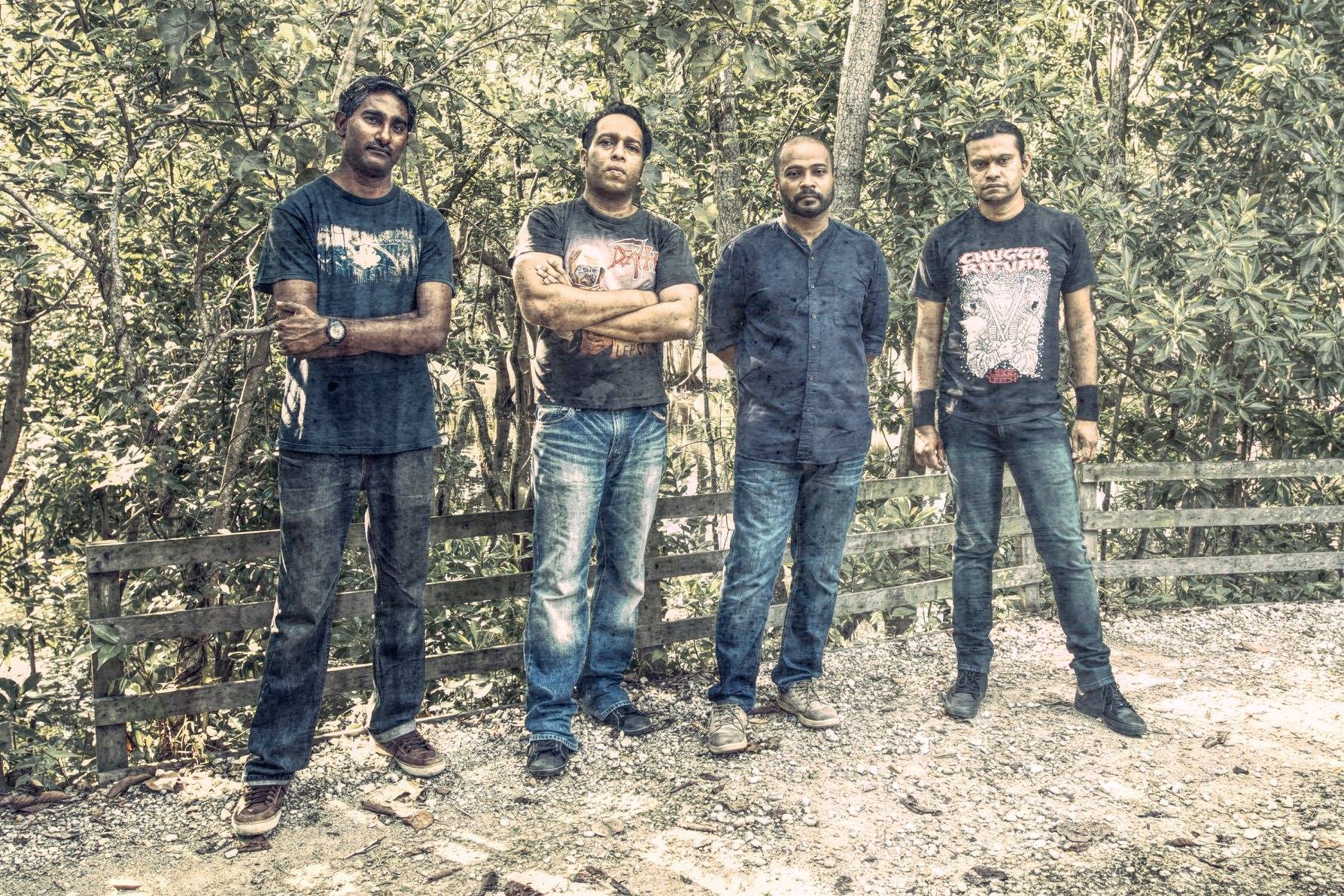
Album Review – Tannoiser / Alamut EP (2018)

An excellent album of crushing, distorted and obscure sounds, courtesy of an Italian power trio ready to spread darkness in the name of old school Sludge and Doom Metal.

Forged during the summer of 2015 in Salò, a town and comune in the Province of Brescia in the region of Lombardy on the banks of Lake Garda, in Italy, Stoner/Doom Metal power trio Tannoiser is a reality among us with their slow and obscure music inspired by cult acts such as Celtic Frost, Electric Wizard and Cathedral, also inserting some stylistic elements dear to the primordial Black Metal into the mix. Comprised of Bruno Almici on vocals and bass, Francesco Bellucci on the guitar and Davide Serpelloni on drums, Tannoiser are unleashing upon humanity their brand new EP, entitled Alamut, aiming at spreading darkness through their low-tuned, rumbling instruments and screams, all in the name of old school Doom Metal.

The name of the album is a clear reference to the mountain fortress, whose remains are located in the current Iran and which served as the basis for the sect of the Nizarites, better known as Hashashin, a story distinguished by mysteries that weave reality and legend. The dark, also understood as a lack of certainties, is another underlying macroscopic theme, starting from the subject chosen for the cover itself, the cannabis plant, whose history in the last century has been characterized by obscurantism and demonization, and which is linked to the history of the stronghold of Alamut. Musically speaking, as aforementioned Alamut brings to the listener doomed and distorted heavy music that lives up to the legacy of the genre, turning the album into a must-listen for diehard Doom Metal fans in pursuit of fresh alternatives in the market.

In the opening track, curiously named Baba Vanga after a blind Bulgarian mystic, clairvoyant, and herbalist, a beyond weird intro quickly explodes into piercing and rumbling Stoner Metal led by the low-tuned bass and the anguished roars by Bruno, while Francesco slashes his strings in a vibrant fusion of old school Doom Metal and modern Rock N’ Roll. And the trio wastes no time and keep firing their fun and vibrant Stoner Metal in Paradacsa, with the bass punches being nicely supported by Davide’s steady and fierce beats. Moreover, the song presents an even more menacing vibe than its predecessor, being highly recommended for banging your head really hard in pitch black darkness; whereas the scorching hot buzzing blasted by Bruno from his bass ignites a somber Doom Metal feast titled Necrophage, where he also growls in a perturbing way while Davide keeps pounding our heads with his drums, with the music flowing demonically until its crushing finale.

March of Wrecks continues to pave the power trio’s path of obscurity, anger and pain, even bringing more aggressive nuances from Black Metal to their dense musicality, with Francesco doing an awesome job with his razor-edged riffs, while The Void showcases the most serene start of all songs from the EP, sounding melancholic and eerie with Bruno’s Stygian bass lines taking the lead while Francesco’s guitar lines once again bring electricity to the music. Then it’s Davide who takes care of kicking off their last breath of top-of-the-line Doom and Stoner Metal, titled Mekkano, remaining as dark as doomed music can be, with all band members adding their touch of malignancy to the sonority, especially Francesco with his mesmerizing riffs.

Entering the dark and sluggish world of Tannoiser is quite easy, as all you need to do is follow them on Facebook, subscribe to their YouTube channel, and of course purchase your copy of Alamut (available for a full listen on YouTube and on SoundCloud) directly from their BandCamp page or from Amazon. Tannoiser were spot on with their thrilling fusion of Stoner and Doom Metal in Alamut, and apparently the band will only grow stronger and stronger as time goes by, pointing to a bright future not only for the band but for the entire genre as well.

Best moments of the album: Baba Vanga and March of Wrecks.

Worst moments of the album: None.

Released in 2018 Leynir Booking & Prod

Track listing
1. Baba Vanga 4:11
2. Paradacsa 5:33
3. Necrophage 5:20
4. March of Wrecks 3:59
5. The Void 5:52
6. Mekkano 4:38

Band members
Bruno Almici – vocals, bass
Francesco Bellucci – guitar
Davide Serpelloni – drums

Album Review – Akhenaten / Golden Serpent God (2018)

Steeped in the mythology and mysticism of ancient Egypt and Mesopotamia while exploring forgotten paths of history, here comes an infernal duo armed with their brand new opus of crushing Blackened Death Metal.

Forged in 2012 in the fires of Manitou Springs, a resort city in Colorado, in the United States by the “Houseman Brothers” Wyatt Houseman on vocals and Jerred Houseman on all other instruments, here comes a unique and vibrant Black/Death Metal studio project infused with Middle Eastern Folk Influences (even called “Blackened Mesopotamian Folk/Death Metal”) known as Akhenaten with their brand new album Golden Serpent God, steeped in the mythology and mysticism of ancient Egypt and Mesopotamia while exploring forgotten paths of history, extracting unknown lore and threads of truth. For instance, Akhenaten, known before the fifth year of his reign as Amenhotep IV, was a pharaoh of Egypt especially noted for abandoning traditional Egyptian polytheism and introducing worship centered on the Aten, giving you a very good idea of how distinct and aggressive the music by the duo sounds.

With parallel themes to what’s found in the brother’s Symphonic Black Metal band Helleborus, and featuring an imposing cover artwork by Tony Koehl of Sketch The Soul and a title page artwork by Dennis Lee Hughes of Cythraul Art, Golden Serpent God will appeal to fans of the music by bands such as Al-Namrood, Narjahanam, Melechesh and Kartikeya just like what happened in their previous release Incantations Through the Gates of Irkalla, from 2015, whispering to the most remote regions of primal memory to the sound of their Blackened Death Metal, filled with exotic instruments and rhythmic structures of the ancient Near and Middle East. “The album is a mural of epics from Egypt and Mesopotamia. It tells stories of belief, warfare, men and Gods,” said Jerred about their newborn opus, inviting the listener to an idiosyncratic and extreme music journey together with the duo.

In the excellent opening track, titled Amulets of Smoke and Fire, ominous sounds take us to the Mesopotamian world of Akhenaten, with Jerred generating a dark and embracing atmosphere with his scorching riffs, whimsical keyboards and demonic beats, while Wyatt growls like an Egyptian beast; followed by the also imposing and devastating Dragon of the Primordial Sea, where the guitar and bass lines create a beautiful paradox with the epicness flowing from keyboards, while Wyatt declaims the song’s lyrics with his deep, visceral growls, enhancing the song’s taste and impact even more, creating an instant link with the crushing chant Throne of Shamash, where the drums by Jerred get more and more demolishing as the music progresses in an excellent display of classic Blackened Death Metal, feeling like a battle hymn due to its thunderous vibe.

Then Middle-Eastern and folk elements permeate the air in the captivating instrumental bridge Through the Stargate, setting the stage for Akhenaten to smash our senses in Erishkigal: Kingdom of Death, a full-bodied, metallic feast of darkened sounds and nuances where the Houseman Bothers are absolutely on fire and in total sync, with highlights to the rumbling sounds extracted from guitars and bass. And things get even more thrilling as the strident and piercing sound of keyboards take the lead in the melodic aria titled Pazuzu: Harbinger of Darkness, the perfect union of history, myths and metal music, with the vociferations by Wyatt matching the musicality flawlessly, whereas in Akashic Field: Enter Arcana Catacombs get ready for over seven minutes of tribal beats and Middle-Eastern tones and nuances in another fresh instrumental extravaganza by this talented band, with Jerred blasting hypnotizing beats while the atmosphere remains as cryptic as it can be.

Featuring Brian Palmer (Circaic) on the guitar, God of Creation is the most devastating and modern composition by Akhenaten, with Wyatt growling like a demonic entity while Jerred makes sure the ambience remains as violent as possible in a multi-layered, intricate feast of Black and Death Metal for our avid ears. After such furious explosion of extreme music we have another interesting display of Middle-Eastern music infused with Extreme Metal and even futuristic elements entitled Sweat of the Sun, sounding a bit too weird at times (not to mention it could have been slightly shorter and more metallic), while in Apophis: The Serpent of Rebirth the duo gets back to their more incendiary mode, blasting a potent fusion of Progressive and Blackened Death Metal, being therefore tailored for fans of bands like Behemoth. Furthermore, the intricacy flowing from guitars and bass are the exact background Wyatt needs to thrive with his gnarls, flowing like a firestorm until the music fades into the atmospheric and vibrant outro Golden Serpent God, with all its hypnotizing sounds generating an enfolding and obscure finale for such heavy and captivating album.

In case you want to explore in more detail the vast and eccentric realm of Akhenaten, simply pay them a visit on Facebook for news and other nice-to-know details, and grab your copy of Golden Serpent God (available for a full listen on YouTube, on Spotify and on SoundCloud) from their BandCamp page, from the Satanath Records’ BandCamp page, from the Cimmerian Shade Recordings’ webstore, from iTunes, from Amazon or from Discogs. Akhenaten offer you a one-way ticket into the blackened and mysterious lands of ancient Egypt and Mesopotamia in Golden Serpent God, and I’m sure such distinguished experience will deeply encourage you to stay there and not come back of your own free will.

Best moments of the album: Dragon of the Primordial Sea, Pazuzu: Harbinger of Darkness and God of Creation.

Worst moments of the album: Sweat of the Sun.

Released in 2018 Satanath Records/Cimmerian Shade Recordings/Murdher Records

Track listing
1. Amulets of Smoke and Fire 3:42
2. Dragon of the Primordial Sea 3:22
3. Throne of Shamash 2:50
4. Through the Stargate 2:35
5. Erishkigal: Kingdom of Death 4:03
6. Pazuzu: Harbinger of Darkness 4:09
7. Akashic Field: Enter Arcana Catacombs 7:05
8. God of Creation (feat. Brian Palmer) 3:22
9. Sweat of the Sun 5:59
10. Apophis: The Serpent of Rebirth 5:49
11. Golden Serpent God 2:44

Band members
Wyatt Houseman – vocals
Jerred Houseman – all instruments

Guest musicians
Brian Palmer – guitars on “God of Creation”
Rose White – female vocals

Album Review – Nachtlieder / Lynx (2018)

Witness the lynx, the antagonist of the antagonists and a symbol for knowledge and clairvoyance, in the form of the beastly Black Metal by Dagny Suzanne’s alter-ego, sticking its claws deep inside your flesh.

Our beloved Swedish Valkyrie of Black Metal, the talented multi-instrumentalist Dagny Suzanne, is finally back with her incendiary alter-ego Nachtlieder three years after the release of the excellent The Female Of The Species, showcasing another evolutionary step in her interesting and fruitful career with her third full-length album, simply titled Lynx. Once again accompanied by Martrum on drums, and with the fantastic support of the skillful Déhà (Musical Excrements), who not only provided some additional vocals and noises on the album but who also produced, mixed and mastered it, Nachtlieder will stick her claws deep inside your flesh with Lynx, proving her creativity and energy are soaring at this stage of her life.

Featuring a beautiful cover art based on a painting named Guldnyckeln by John Bauer, from 1915, and a digipack booklet portrait of Dagny by I Breathe Needles, the title of the album refers to the lynx as the antagonist of the antagonists (the wolves) and also as a symbol for knowledge and clairvoyance. The theme of the album is largely death and solitude, with many references to the lynx in cultural history, as well as to science in general. In other words, our Gothenburg-based she-wolf doesn’t just deliver high-quality music for our avid ears, but there’s also a lot to savor and learn in Lynx, one of those albums that you’ll get addicted to from the very first second without even noticing.

Distorted, wicked noises ignite a Black Metal feast entitled Claws and Bone, feeling more melodic and dissonant than the project’s previous albums, with Dagny sounding beautifully hellish and somewhat cryptic on vocals and on the guitar while Martrum adds a welcome dosage of intricacy to the music with his beats. Then we have the furious title-track Lynx, a song that grows in intensity until it reaches a pulverizing and mesmerizing tone, with the strident guitars by Dagny being flawlessly complemented by Martrum’s classic Black Metal beats and fills, resulting in a full-bodied sonority tailored for fans of modern-day Extreme Metal; followed by Song of Nova, an explosion of dark, crisp and low-tuned tones embellished by harmonious background elements, also presenting some welcome neck-breaking passages and Dagny’s usual poetic lyrics, giving even more depth to her already exhilarating music (“Dark frequencies, succumb to by every beast / As nova has swallowed the last light / And resigns / Their limbs tremble as the chords are strung / Fragile glass that shatter / Shards that dissolve into dust”).

The next tune, titled Nameless, Faceless, presents a creepy intro showcasing dark vociferations by Dagny, evolving into classy Scandinavian Black Metal with a superb job done by Dagny with both her slashing guitar lines and rumbling bass lines, flowing smoothly and powerfully from start to finish, whereas Law of Decay is a first-class, infuriated display of flammable and straightforward Black Metal, offering the listener a massive wave of classic riffs, unstoppable beats and those demonic, Stygian growls we all love so much in this type of music. And Dark Matter sounds closer to the music found in her two previous albums, especially the sound of the guitars and the hypnotizing music structure and pattern, with all instruments emanating metallic sounds that end up creating an enfolding atmosphere that will certainly captivate all your senses.

Eyes Ablaze, which brings forward what’s perhaps the most carnivore lyrics of the whole album (“Eyes, eyes staring in the dark in the misty night, eyes ablaze / Only star and spectre / Dare to meet my gaze / Claw, clawing round the walls round the bodies of the game / For carnage and grim sight / I will be to blame / Teeth, teeth sunken into meat into warm flesh, then like a flood / Fallen sheep and hound / Lapping blood”), is a rip-roaring Black Metal onrush that will leave you absolutely disoriented, showcasing an amazing performance by Martrum on drums while Dagny’s scorching riffs and visceral gnarls will crush your soul. And last but not least we have Moksha (a term in Hinduism, Buddhism and Jainism which refers to various forms of emancipation, liberation and release), bringing more of Dagny’s unparalleled music combined with the precision and complexity of Martrum’s drumming, therefore offering the listener over six minutes of classic Black Metal with a fresh twist, with all instruments getting heavier, darker and more piercing as the music progresses before all devastation gives place to a somber and atmospheric ending.

In summary, like what happened with Nachtlieder’s self-titled debut album in 2013 and The Female of the Species in 2015, Lynx is more than just a detailed and thrilling album of classic Black Metal, becoming Dagny’s outlet to the outside (and always dangerous) world we live in, and due to those additional layers the album ends up growing on you with each and every listen, revealing to your ears and mind previously unexplored grounds and nuances. Hence, if you want to venture through the realms of Natchlieder and Lynx deeper and deeper, you can enjoy the full album on YouTube and on Spotify, but of course the most recommended way to do so is by purchasing the album from Nachtlider’s BandCamp page, as well as from iTunes, Amazon and Discogs, always keeping an eye on the project’s official Facebook page for news and other nice-to-know details. As the beast called Lynx has just been unleashed upon humanity, the only thing that’s left for us to do is succumb to its music and energy, all in the name of meaningful extreme music.

Best moments of the album: Song of Nova, Law of Decay and Eyes Ablaze.

Worst moments of the album: None.

Released in 2018 Nigredo Records

Track listing 
1. Claws and Bone 4:31
2. Lynx 3:52
3. Song of Nova 5:22
4. Nameless, Faceless 5:04
5. Law of Decay 4:25
6. Dark Matter 4:47
7. Eyes Ablaze 3:56
8. Moksha 6:19

Band members
Dagny Susanne – vocals, all instruments

Guest musicians
Martrum – drums
Déhà – additional vocals, noise

Album Review – Paths / In Lands Thought Lost (2018)

An impending opus of Scandinavian-inspired Black Metal infused with the bitterly cold and somber sounds of the Pacific Northwest, generating a stunning and vicious atmosphere that will beautifully embrace your soul.

Formed in 2013 in the city of Victoria, in the Canadian province of British Columbia, by vocalist and multi-instrumentalist Michael Taylor, Atmospheric Black Metal project Paths has evolved from its psychedelic-laced Black Metal beginnings to embrace more of a grand in scope atmosphere, more properly upholding and defining the beauty of their surroundings through the dense music they create. Hence, that evolution in the music by Paths is beyond clear with their impending third full-length album, entitled In Lands Thought Lost, a powerful and dense fusion of Scandinavian-inspired Black Metal with the bitterly cold and somber sounds of the Pacific Northwest, generating a stunning and vicious atmosphere that will beautifully embrace your soul.

Featuring an austere artwork by Sólfjall Design, as well as Austin Lunn from Panopticon as a sessions drummer (who by the way volunteered to re-record drums for the album to replace Michael’s carefully constructed synthetic drums for a more organic result), In Lands Thought Lost can be considered the most stylistically developed full-length from this crushing musical entity known as Paths, uniting melody and atmosphere in a puissant Black Metal vibe that summons your spirit back to the 90’s in each of its five distinct but thoroughly connected songs, showcasing how focused Michael was when writing this amazing album of extreme music.

In the opening track, a multi-layered and visceral creation titled Nights Tomb, a short intro explodes into brutal and atmospheric extreme music, with Michael becoming a beast with his demonic gnarls and crushing riffage while Austin makes sure the music flows demonically with his blast beats, invading your mind like a giant dark wave of sounds. Then we have To Brave The Storm, another classic and vibrant Atmospheric Black Metal extravaganza sounding and feeling more melodic and anguished than its predecessor, with Michael being flawlessly supported by the unstoppable Austin and his rhythmic beats and fills, with the song’s visceral guitar lines emanating a mesmerizing and creepy vibe from start to finish. And the song’s abrupt finish sets the stage for the melancholic Creaking Boughs, also traveling through the realms of modern Atmospheric Black Metal, with the intensity of the beats growing together with the lancinating growls by Michael, who also fires some delicate guitar solos embraced by the song’s furious ambience. Furthermore, a gentle break provides the listener some time to breathe, before the music once again bursts into blackened sounds and tones.

The following tune, entitled The Everbright Land, kicks off in full force with Austin taking the lead with his demolishing beats, while Michael makes sure his growls and gnarls are in total sync with his obscure guitar lines and background phantasmagorical keys. Moreover, his bass lines also bring thunder to the musicality in the most Black Metal of all songs, with the music remaining disturbing, harmonious and electrifying in its entirety for our total delight. And finally, ethereal sounds ignite the longest and most intricate of all songs, South Ever South, blending the introspection of Doom Metal with the band’s characteristic Atmospheric Black Metal, with its bass lines presenting a mournful tone in contrast with the enfolding sound of the keyboards. Sometimes their most Black Metal side dictates the rhythm, sometimes it’s their doom-ish and atmospheric vein that takes the lead, until desolate and Stygian sounds put a climatic end to Paths’ obscure journey.

In summary, In Lands Thought Lost is not only a top-of-the-line album of Atmospheric Black Metal highly recommended for fans of the genre, but the precision and dedication the mastermind behind Paths, the aforementioned Michael Taylor, put in the development of the album is so compelling to the point all of us fans of extreme music should start beginning him to turn Paths into a full-bodied group or at least into a live band, allowing us to admire his music in the most organic way possible, which is on stage. I have no idea if that’s ever going to happen, but we can all go “bother” Michael on the project’s official Facebook page, and of course inspire him to write more music by purchasing In Lands Thought Lost as soon as the album becomes available on the Bindrune Recordings’ BandCamp and webstore in digital format or as a red vinyl (limited to 500 copies). As a matter of fact, if you’re an admirer of Atmospheric Black Metal, I’m pretty sure you’re already well aware of that, eager to have such inspiring album on your metallic hands.

Best moments of the album: Nights Tomb and The Everbright Land.

Worst moments of the album: None.

Released in 2018 Bindrune Recordings

Track listing    
1. Nights Tomb 7:32
2. To Brave The Storm 8:40
3. Creaking Boughs 8:43
4. The Everbright Land 9:11
5. South Ever South 12:33

Band members
Michael Taylor – vocals, all instruments

Guest musician
Austin Lunn – drums (session)

Album Review – Progenie Terrestre Pura / starCross EP (2018)

Embark on an exciting journey across the stars with the new concept album by this Italian Atmospheric Black Metal act, representing a further evolutionary step in their distinct career.

Initially announced as a complementary EP to last year’s album oltreLuna, the new album by Italian Atmospheric Black Metal act Progenie Terrestre Pura (which translates as “Pure Terrestrial Progeny”), entitled starCross, turned out to be an even more powerful and impressive opus than this Veneto-based band comprised of Emanuele Prandoni on vocals, Davide Colladon on guitars, drum programming and synths, and Fabrizio Sanna on bass could have imagined. Featuring a classy artwork by visual artist Kuldar Leement, starCross uses its 30 minutes to tell a precise story, as the EP is an all-round concept release based on a tale written by the band’s mastermind Davide Colladon.

In order to make the release fully understandable beyond the Italian borders, the band decided to use English for the first time in their career. The music, either, is very different from what could be heard on everything Progenie Terrestre Pura (also known as “q[T]p”) ever released since their inception in 2009. “starCross represents a further evolutionary step for qTp”, says Colladon, “its sound is extremely connected to the story it tells, which is pretty dark. My intention was to recall thrilling sci-fi masterworks such as Ridley Scott’s Alien, Grant Morrison’s Nameless and the Dead Space videogame saga.” In other words, get ready to embrace fear, madness and despair in the darkest Progenie Terrestre Pura release to date, and prepare yourself for what might be your last trip across the stars.

The band wastes no time in starCross by offering us Chant of Rosha, an atmospheric, futuristic intro from outer space, enfolding us and taking us to the whimsical world of Progenie Terrestre Pura, warming up our senses to the breathtaking Toward a Distant Moon, an explosion of the most disruptive elements from Black Metal led by the razor-edged guitar lines by Davide, with Emanuele’s enraged growls creating an electrifying paradox with the excellent background choir, remaining vibrant, ethereal and aggressive from start to finish for our total delight. And that electricity keeps permeating the air, as the music builds a cinematic connection with the also impactful Twisted Silhouette, starting in an eerie manner with a dark narration before all hell breaks loose, with the song’s demolishing beats together with Davide’s crisp riffs and Fabrizio’s thunderous bass building the perfect stage for Emanuele to fire his harsh growls, also adding tons of progressiveness to its core. In the end, you’ll get deliciously lost in all the madness, wicked noises and flammable sounds blasted by the band throughout the entire song.

Progenie Terrestre Pura starCross A5 Digipack Edition

The Greatest Loss also showcases a modern and creepy intro that morphs into a blend of Atmospheric Black Metal with Industrial Metal, with all mechanized elements and nuances bringing an extra touch of lunacy to the overall result. Furthermore, Davide does a superb job with his guitar and synths by generating a menacing ambience perfect for Emanuele’s growls, with the last part of the song being a heavier version of the industrial music played by bands like Ministry and KMFDM. And finally, q[T]p’s last blast of obscure, futuristic movie-inspired music comes in the form of a bizarre outro named Invocat, where future meets past with electrified and cold, mechanic sounds being complemented by a background Gregorian chant.

Do you have what it takes to join q[T]p in their metallic space odyssey? If the answer is yes, you can get to know more about the band, their tour dates and future plans on their official Facebook page, and purchase starCross (available for a full and detailed listen on YouTube and on Spotify) from their own BandCamp page, as well as from the Avantgarde Music’s BandCamp page or Big Cartel as a very, very special A5 Digipack CD, showcasing a brand new  artwork (courtesy of Italian artist Ballak., who gave a face and a spaceship to the main character of the starCross concept, Robert I.C. Cross) and including the storyline of the EP in its entirety. You can also buy it from other regular retail places such as iTunes, Amazon and discogs (in vinyl or CD format), but if I were you I would certainly go for the A5 Digipack edition of the album, because if you’re going on a musical voyage through the stars, you better be armed with the best weapon and soundtrack available at the same time, right?

Best moments of the album: Toward a Distant Moon and The Greatest Loss.

Worst moments of the album: None.

Released in 2018 Avantgarde Music

Track listing 
1. Chant of Rosha 2:22
2. Toward a Distant Moon 6:41
3. Twisted Silhouette 8:02
4. The Greatest Loss 7:50
5. Invocat 4:31

Band members
Emanuele Prandoni – vocals
Davide Colladon – guitars, drum programming, synths
Fabrizio Sanna – bass

Album Review – Unflesh / Savior (2018)

A dark, aggressive and extremely technical opus of Blackened and Melodic Death Metal by a four-headed American beast, sounding as pulverizing as extreme music can be.

Forged in 2014 in the fires of Portsmouth, New Hampshire, in the United States as a solo project of vocalist and multi-instrumentalist Ryan Beevers (Solium Fatalis), who’s by the way a student at the highly prestigious Berklee College Of Music, but currently located in Boston, Massachusetts, Blackened Melodic Death Metal four-piece squad Unflesh has been on a roll since their inception, having already released an excellent EP in 2016 titled Transcendence to Eternal Obscurity (which featured the astounding German drummer Hannes Grossmann as a session musician), followed by their new and insanely heavy and entertaining album Savior. Featuring a beautiful and menacing artwork by Brazilian artist Junki Sakuraba, Savior will strongly appeal to fans of the unparalleled music by bands such as Dissection, Necrophagist, Emperor, Fleshgod Apocalypse and Dimmu Borgir, among others, placing the band comprised of the aforementioned Ryan Beevers on vocals and guitar,  Chris Gardino (Pathogenic, Wolfsmyth) on the guitar, Peter De Reyna (Seven Spires) on bass and Chris Dovas (Seven Spires) on drums as one of the most promising names of the current underground scene.

Ryan Beevers himself had a few words to say regarding Savior, giving more details on the direction he wanted to follow with his brainchild.  “I’ve always thought of the band as having a kind of mixed sound of 90’s black metal and more technical death metal bands. Since the band started I just called us “Extreme Metal” because it’s a broader label. I never thought the sound of the band would be described as just black metal or death metal. When the first EP “Transcendence to Eternal Obscurity” came out, most people seemed to identify the sound as technical death metal. This album is one more step forward in molding the sound of Unflesh, musically and lyrically the ‘Savior’ album is a lot darker and more aggressive than our previous EP,” said Ryan about his new opus, one that he definitely should be proud of, and one we should all thank him for providing to us, avid metalheads.

An eerie piano intro grows in intensity until progressiveness and sheer devastation invade our senses in the opening track Savior, thanks to the fulminating riffs by Ryan and Chris Gardino as well as the bestial drumming by Chris Dovas. In other words, it’s a dense and intricate depiction of modern-day Progressive and Melodic Death Metal, and a fantastic welcome card by the entire band. Following such breathtaking beginning we have Bestowal of Decay, bringing an avalanche of groove and complexity, being even more demonic than the opening tune with Ryan sounding hellish and demented on vocals, all complemented by some sick guitar solos and some ass-kicking, classic Death Metal lyrics (“The great fade of all life in the dawn / A blissful perception of the fathomless darkness obtained / Primeval scriptures deciphered before the mortal eyes / By forsaken powers of Unanimation / Unveiled”); and their destructive but very harmonious onrush of Black and Death Metal goes on in Final Writhe, an incendiary tune led by the mesmerizing riffs and solos by both Ryan and Chris Gardino, with Chris Dovas showing no mercy for his drum set while Peter brings density and darkness to the music with his unstoppable punches.

More rhythmic and presenting what’s perhaps the most intricate and thrilling beats of the entire album, always supported by Peter’s thunderous bass, Erosive Devotees presents an enraged Ryan growling and screaming nonstop, turning it into one of the top moments of the album, whereas in The Eradication Commenced the band fires more of their electrifying Blackened and Melodic Death Metal with no sign of slowing down at all. Quite the contrary, the band’s stringed trio is on fire from start to finish, slashing our ears beautifully while Chris Dovas adds hints of Doom and Black Metal to his beats and fills. And Caliginous is an even more progressive and melodic tune by Unflesh, with Ryan gnarling in perfect sync with the guitar lines and beats blasted by the rest of the band. Put differently, you can break your neck headbanging or simply close your eyes and enjoy the complex music waves of this multi-layered extravaganza. Either way, you’re going to have an awesome time.

Then a pulverizing display of dexterity and rage waits for us in Desecration of Light, a circle pit-catalyst with all ingredients we love in contemporary Extreme Metal where Chris Dovas will crush your skull with his demonic beats, while Ryan and Chris Gardino have an exciting guitar duel with their wicked riffs and solos, before a superb guitar solo introduces us to another scorching hot voyage through the realms of violence and progressiveness in Disintegration God, ending with another gorgeous guitar solo until everything fades into ethereal sounds, with its classic lyrics being the icing on the cake (“And the somber thrives as animation subsides / When all designed under a star descends into infinity / Predestined fall, all-encompassing fade of life / It corrodes away before the throne of Death / And into its sacred lore”).

In order to let Unflesh penetrate deep inside your mortal flesh with the top-tier metal music found in Savior, simply pay them a visit at their Facebook page and YouTube channel, and buy your copy of the album form their own BandCamp page or webstore, as well as from iTunes, Amazon and CD Baby. The monstrous beast known as Unflesh is more menacing, violent and cohesive than ever, and I’m sure not only the band’s talented originator is happy with the devastating potential of his infernal spawn, but also anyone else who loves the perfect fusion of aggressiveness, feeling and technique in extreme music.

Best moments of the album: Bestowal of Decay, Erosive Devotees and Desecration of Light.

Worst moments of the album: None.

Released in 2018 Independent

Track listing
1. Savior 5:04
2. Bestowal of Decay 5:23
3. Final Writhe 5:13
4. Erosive Devotees 5:22
5. The Eradication Commenced 5:13
6. Caliginous 5:17
7. Desecration of Light 4:26
8. Disintegration God 5:35

Band members
Ryan Beevers – vocals, guitars
Chris Gardino – guitars
Peter De Reyna – bass
Chris Dovas – drums

Guest musician
Anthony Lusk-Simone – additional orchestral elements

Album Review – Et Moriemur / Epigrammata (2018)

Transcending the perceptions of the death and doom styles and bringing back forgotten elements from the past, the new opus by this talented Czech band perfectly depicts our attempt to cope with the death of those we loved.

Founded in 2008 in Prague, in the Czech Republic, Atmospheric Black/Death/Doom Metal supergroup Et Moriemur, featuring members of legendary bands like Dissolving of Prodigy, Self-Hatred and Silent Stream of Godless Elegy, has been spreading what they like to call “Existential Doom” all over the world ever since. The name of the band, which is Latin for “and we will die”, already says a lot about how obscure and damned their music sounds, with their brand new album Epigrammata, the third in their already solid career, transcending the perceptions of the death and doom styles and bringing back forgotten elements from Gregorian chanting, delving into the rich European history and using Latin and ancient Greek to convey their message. Featuring an array of amazing guest musicians, Epigrammata has all of its song names in Latin taken from the Requiem Mass, notable for the large number of musical compositions that it has inspired, including settings by Mozart, Verdi, Bruckner, Dvořák, Fauré and Duruflé. Originally, such compositions were meant to be performed in liturgical service, with monophonic chant.

The band, comprised of Zdeněk Nevělík on vocals, piano and keyboards, Aleš Vilingr and Pavel Janouškovec on the guitars, Karel Kovářík on bass and Michal “Datel” Rak on drums, had a few interesting words to say about their new album. “Epigrammata represents our attempt to cope with the dying or death of those we loved. To create a solemn and classical atmosphere we used lyrics in ancient Greek (the title itself means epigrams) and in Latin, more precisely from the Mass for the dead – the album follows the typical Requiem structure, i.e. Introitus, Requiem Aeternum, Dies Irae etc. – and of course the traditional, unisono male Gregorian chant. In any case we tried not to do a uni-dimensional record. So apart from the inevitable grief there is gratitude as well for having had the chance to share our life with them and hope that they are well – wherever they are.”

Whimsical waves invade our senses in Introitus (or “prelude”), with guest Kostas Panagiotou bringing epicness to the intro with his enigmatic words before a massive wall of sounds crushes us all in Requiem Aeternam (“eternal rest”), with the doomed, sluggish beats by Datel and the imposing background choir generating a truly Stygian ambience. Furthermore, Zdeněk sounds as demonic as he can be, not to mention the potency of the music coming from the violin and cello. Then the piano by Zdeněk kicks off a Blackened Doom extravaganza titled Agnus Dei (“lamb of god”), a song that reeks of sheer darkness where cavernous growls get deeper and deeper in a delicate paradox with the smother background elements. In addition, Guest musicians Labrini Karousou and Vangelis Mertzanis provide another anguished and eccentric narration, feeling more doomed than atmospheric, and absolutely haunting and dense from start to finish. And their somber mass of Doom and Black Metal goes on with another fantastic hymn titled Dies Irae (“day of wrath”), with the band’s stringed trio Aleš, Pavel and Karel being extremely precise with their scorching, damned riffs and punches, and with the keyboards by Zdeněk sounding beautifully eccentric and wicked.

In Offertorium (“offering”) we’re treated to a Phantom of the Opera-like vibe blended with the band’s otherworldly sounds and tones, with Datel simply smashing his drums slowly and flawlessly while the choir keeps mesmerizing our minds, remaining dark and vibrant until its grand finale; whereas in the slightly faster and more piercing Communio (“communion”), Et Moriemur continue to fire their low-tuned, demonic tones intertwined with the church-like choir and a huge dosage of melancholy, maintaining the album at a vibrant and perturbing level. And in Libera Me (“rescue me”) an eerie organ together with the cavernous growls by Zdeněk generate a truly enfolding atmosphere, evolving into a lecture in Blackened Doom infused with church music elements. Furthermore, the entire band is utterly focused and energized, extracting the most damned but at the same time melodious sounds you can think of from their instruments, with every single second of this aria being beyond captivating (especially the final recitation by Zdeněk).

Then the piano by Zdeněk dictate the rhythm in Absolve Domine (“release lord”), complemented by his pensive words and cinematic-epic-imposing background sounds, with the music growing beautifully until darkness is upon us once again in the Blackened Doom aria Sanctus (“spirit”), a headbanging mass led by the crawling, gloomy beats by Datel. Hence, this amazing composition will elevate your senses with its potent sonority, not to mention how the entire band is capable of sounding so devilish and gentle at the same time. Lastly we have In Paradisum (“in paradise”), a 10-minute voyage through the realms of Existential Doom where its first part is pure old school Doom Metal, until anguished lamentations permeate the air in one of the most obscure and hypnotizing metal masses I’ve ever listened to in my life. In addition, the song’s sluggish drums, serene guitars and epic keys will penetrate deep inside your soul, with an ethereal feminine voice ending this top-notch album of Atmospheric Doom Metal majestically.

Et Moriemur are one of those bands you won’t listen to anywhere but only during your moments of introspection and melancholy, with Epigrammata representing everything the band stands for in terms of music and lyrical themes. And in order to show your support to such distinguished band, go follow them on Facebook and grab your copy of Epigrammata directly from their BandCamp page or from the Transcending Obscurity Records webstore in a Digipak CD + sticker bundle, as well as from iTunes, Amazon, CD Baby and Discogs. However, if you prefer an exclusive and more stylish version of the album, I highly recommend you go after the Epigrammata Gold-embossed and UV-laminated Box Set, containing the digipak CD with booklet, an A3 size poster having a special artwork, a fridge magnet having the album artwork, two stickers of the album artwork + emblem artwork, and an individual hand-numbered certificate of ownership for your copy. It can’t get any better, more doomed and more obscure than this, and I’m sure you’re going to love it.

Best moments of the album: Agnus Dei, Libera Me and Sanctus.

Worst moments of the album: None.

Released in 2018 Transcending Obscurity Records

Track listing
1. Introitus 1:41
2. Requiem Aeternam 5:15
3. Agnus Dei 5:14
4. Dies Irae 4:12
5. Offertorium 5:44
6. Communio 6:14
7. Libera Me 5:18
8. Absolve Domine 2:47
9. Sanctus 6:05
10. In Paradisum 10:41

Band members
Zdeněk Nevělík – vocals, piano, keyboards
Aleš Vilingr – guitar
Pavel Janouškovec – guitar
Karel Kovářík – bass
Michal “Datel” Rak – drums

Guest musicians
Kostas Panagiotou – vocals on “Introitus”
Nikos Vlachakis – vocals on “Agnus Dei”
Labrini Karousou & Vangelis Mertzanis – recitation on “Agnus Dei”
Jaroslav Klvaňa, Karel Russ & Lukáš Pavlovský – choir
Andrea Michálková – cello
Zuzana Králová – violin
Jindřich Bešťák – trombone
Honza Kapák – acoustic guitar

Album Review – Marduk / Viktoria (2018)

A furious and aggressive fusion of Marduk’s classic Black Metal with their more contemporary warlike sound, proving once again why they’re one of the biggest names in the history of extreme music.

Following a similar (and obviously amazing) pattern from their previous albums, focusing on historical World War II lyrical themes like what they did in the demolishing Frontschwein, released in 2015, Swedish Black Metal regiment Marduk returns to the battlefield with another skull-crushing release, entitled Viktoria, the fourteenth studio album in the undisputed career of those Babylonian gods of extreme music. From the devastating sonic assault blasted by the band on the opening track “Werwolf” to the very last second in the closing tune “Silent Night”, Marduk deliver a furious and aggressive fusion of their classic Black Metal with their more contemporary warlike sound, proving once again why they’re one of the biggest names in the history of extreme music.

And the horde comprised of Daniel “Mortuus” Rostén on vocals, Morgan “Evil” Steinmeyer Håkansson on the guitar, Magnus “Devo” Andersson on bass and Fredrik Widigs on drums is not afraid at all of the controversy and negative reaction that the society and the media might have regarding their music and lyrics. “Overall, I would say we have a fascination with the whole war machine,” comments Morgan. “At least from my point of view, the Germans had the most fascinating machinery and equipment. Viktoria is not a standpoint, however. It’s just a reflection of history, the way it happened. With that in mind, it’s more interesting to write a soundtrack tied to specific historical events. Look at movies, for example. They’ve tackled both sides of World War II. So, Viktoria is more about history. Nothing more. Nothing less,” the axeman clarifies.

Werwolf (German for “werewolf”), which was a Nazi plan that began development in 1944 to create a resistance force which would operate behind enemy lines as the Allies advanced through Germany, was the inspiration for the opening track in Viktoria, with the wailing sirens warning about the Black Metal attack that’s about to begin and with Mortuus sounding insane and enraged on vocals while Evil delivers his usual scorching riffs in two intense minutes of extreme music. Following that demonic start we have June 44 (the best known D-Day is during World War II, on June 6, 1944, the day of the Normandy landings, initiating the Western Allied effort to liberate mainland Europe from Nazi Germany), closer to their more classic sonority with Fredrik crushing his drums in a perfect depiction of how warlike Black Metal should always sound, with the rumbling bass by Devo adding more ferocity to the overall result and the lyrics vociferated by Mortuus matching the music flawlessly (“Stubborn Jabos rip the sky / on wings of inferno into chaos / Burnt offering – killing ground / drowning in blood over and over again / See naval fire rain down / living and dead unite in a stream of anguish / A dance in the sands / of Juno and Sword / a waltz in the flames / of June 44”). And their devastation goes on in Equestrian Bloodlust, a straightforward Black Metal blasted by the quartet where Mortuus sounds even more demented than in their previous albums, while Evil and Devo are in absolute sync with their strings, generating those reverberating, evil tones we all love so much.

Tiger I, a German heavy tank of World War II deployed from 1942 in Africa and Europe which final designation was Panzerkampfwagen VI Tiger Ausf. E, gave the Wehrmacht its first armoured fighting vehicle that mounted the 8.8 cm KwK 36 gun. Musically speaking, it feels like a natural “sequel” to Frontschwein’s “503”, also bringing elements of Doom Metal and Blackened Doom; however, it’s not as imposing and a bit generic, despite its austere words (“Teutonic knights of old march once again / Grand horse of steel, sword of flame – the ground is shaking / Massive apparatus of death, 58 tons of hate / unforgivingly rolling in to seal your fate”). Narva, the third largest city in Estonia, suffered devastating bombing raids on March 6 and 7, 1944 by the Soviet Air Force, destrying the baroque old town. By the end of July, 98% of Narva had been destroyed, and the music blasted by Marduk flawlessly depicts the utter devastation that happened in the city, with Fredrik once again sounding bestial on drums while Mortuus growls and gnarls manically (not to mention the song’s uprising ending). In other words, this will certainly inspire fans to slam like beasts into the circle pit during their live concerts. After such awesome tune, the slashing riffs by Evil ignite the heavy and headbanging The Last Fallen, exploding into berserk Black Metal led by Fredrik and his machine gun-like beats and fills, being effectively accompanied by the thunderous bass by Devo.

The title-track Viktoria is that trademark in-your-face Black Metal by Marduk, sounding as frantic and furious as it can be, with Mortuus spearheading the horde with his sick growling. In addition, there’s even space for some welcome progressiveness added to the sound, not to mention how infernal Fredrik sounds behind his drums. Then we have The Devil’s Song, or “SS marschiert in Feindesland” (“SS march in enemy territory”), also known as “Teufelslied” (“The Devil’s song” in German), a marching song of the Waffen-SS (the armed wing of the Nazi Party’s SS organization) during World War II, and Marduk’s “tribute” to that song is simply devastating, with the initial riffs by the bulldozer Evil piercing your brain mercilessly before all hell breaks loose. Last but not least, closing the album we have another somber, sluggish tune inspired by the most demonic form of Doom Metal, named Silent Night, representing the aftermath, the sadness and pain post-war, with a perturbing performance by Mortuus on vocals. and while listening to this crushing chant don’t forget to break your neck and spinal cord with some full-bodied headbanging.

In summary, if you love old school Black Metal and also nurture a deep interested in all things World War I and II, Viktoria is a must-have album in your “collection of evil”. The Swedish quartet takes no prisoners in their battle for extreme music, and their streak of amazing albums just keeps growing with Viktoria, which by the way is on sale at several locations as you can see HERE. Moreover, as Marduk are extremely active in the scene, always touring all over the world, keep an eye on their official Facebook page to be promptly informed of when they’re about to unleash a brutal Black Metal war in your city. Then, after the concert is over, if you’re one of the survivors you can celebrate “Viktoria” together with one of the most important and decimating Black Metal hordes of all time.

Best moments of the album: June 44, Narva, Viktoria and The Devil’s Song.

Worst moments of the album: Tiger I.

Released in 2018 Century Media

Track listing
1. Werwolf 2:02
2. June 44 3:49
3. Equestrian Bloodlust 2:51
4. Tiger I 4:12
5. Narva 4:31
6. The Last Fallen 4:25
7. Viktoria 3:26
8. The Devil’s Song 3:46
9. Silent Night 4:12

Band members
Daniel “Mortuus” Rostén – vocals
Morgan “Evil” Steinmeyer Håkansson – guitar
Magnus “Devo” Andersson – bass
Fredrik Widigs – drums

Guest musicians
Ella Thornell, Moa Asp & Tuva Ekstrand – backing vocals or “Werwolf”

Album Review – Coldbound / The Gale (2018)

Living is an act of courage, and this Melodic Death Metal act from Sweden has the perfect soundtrack for that.

Founded by Greek multi-instrumentalist Pauli Souka in 2012 in Vantaa, a city in Finland that is part of the inner core of the Finnish Capital Region along with Helsinki, Espoo, and Kauniainen, but currently located in Hudiksvall, a Swedish city also known as Glada Hudik due to its hospitality and social life, the heavy-as-hell metal unity known as Coldbound returns with a brand new opus titled The Gale, their first Melodic Death Metal album to date. If you got used to the Black Metal-inspired approach of their previous releases such as their 2015 album Rites Under Moonlight, get ready to be stunned by the new Coldbound, sounding more polished, doomed, darker and, therefore, being highly recommended for fans of Insomnium, Draconian, Swallow The Sun and Wolfheart, among other excellent Scandinavian Melodic Death Metal acts.

Featuring the aforementioned Pauli Souka on vocals, guitars, bass, keyboards and programming, accompanied by Swedish artist Paulina Medepona (also known as Satana Lucia, and who was also responsible for the incredible and obscure album art) and Finnish keyboardist Andras Miklosvari, the concept behind The Gale focuses on memories of nostalgia and personal struggles, having the purpose of raising the awareness of those who suffer from depression, those who have suicidal thoughts or those who feel lonely. The motto of the album, repeated continuously on the song “Shades of Myself” and displayed on the digipak version of it, is “living is an act of courage”, with the album’s lyrics being mostly inspired by personal struggles and somehow promoting optimism through dark times. Such important message  only gets stronger and stronger as the music progresses, showcasing all the talent and hard work of Pauli and his crew and placing them as one of the most interesting names of the current underground scene.

In the intro 61° 43′ N 17° 07 E, which by the way are the coordinates for a point in Hudiksvall, the soothing sound of rain and an ethereal vibe suddenly explode into a feast of extreme music, setting the stage for The Invocation, highly inspired by the dark and pensive music by Insomnium and with Pauli firing his anguished growls while at the same time keeping the music mournful with his Doom Metal-like beats. Needless to say, the song’s lyrics exhale poetry (“Dark is the night, and the veils are drawn of shadows / Dark is the day, while the sun is no longer awake / The sun is calling for your dawn / These words colour countless shades I shall revoke beyond these shores / And drink your fading crimson tear”), and heaviness keeps pounding our heads in the also obscure but very melodic Endurance Through Infinity, where the guitar lines bring a touch of epicness from Folk and Viking Metal, with Pauli making sure we crack our necks in half headbanging to the song’s crushing rhythm.

Enhancing the impact and delicacy of their music thanks to the keyboards by Andras and the stunning vocals by Paulina, Coldbound deliver a touching creation titled The Eminent Light, where the melancholy flowing from the guitars create an interesting paradox with its doomed beats; followed by the title-track The Gale, which kicks off in full force with its Black Metal blast beats and an enfolding atmosphere. Furthermore, this is probably Pauli’s most demonic mode from the entire album, blasting infernal growls and scorching riffs during the whole song, as well as thunderous and dense bass lines. Then we have the fantastic My Solace, with its lyrics taken from the poem book of Kostas Karyotakis titled “Nostalgia” (“My solace will be seen – by scars upon my heart / My solace will be told – by letter of remorse / The bitter greet – a cold farewell / The olden sorrows – that ignite again”). Andras once again brings tons of flavor to the musicality with his keys, while Pauli gives a lesson in dark, melancholic and gripping Melodic Death Metal, flowing majestically until its astounding finale.

Winters Unfold is another neck-breaking creation by Coldbound, with its rhythm and vibe once again presenting hints of Folk Metal and with the strident guitars by Pauli going along flawlessly with his growls; whereas in Shades Of Myself a promising start solidifies into a classic Scandinavian Melodic Death Metal tune, as polished and vibrant as we can expect from a band like Coldbound, and once again with Pauli adding a good amount of intricacy to the overall sound through his beats. Lastly, how about an 11-minute aria of melodic and obscure extreme music entitled Towards The Weeping Skies to conclude the album? In this journey through the dark, the vocals by Pauli get to a point where they can be considered “anguished whispers”, not to mention the outstanding phantasmagorical keys in the background. Hence, you’ll be hypnotized by Pauli’s guitar lines before the music fades into a gentle and touching outro, accompanied by the sound of a heavy and gorgeous tempest.

The Gale is available for a full listen on YouTube and on Spotify, but if I were you I would definitely show my honest support to such distinct act by purchasing the album from their own BandCamp page or Big Cartel (in digipak format or as a digipak + shirt bundle), from iTunes, or from Amazon. Also, don’t forget to pay Coldbound a visit at their Facebook page and YouTube channel, and let their comforting darkness embrace you. If living is an act of courage as Coldbound say, then The Gale might be the perfect soundtrack for that tough but always rewarding adventure.

Best moments of the album: Endurance Through Infinity, The Gale and My Solace.

Worst moments of the album: None.

Released in 2018 Moonlight Productions

Track listing
1. 61° 43′ N 17° 07 E 2:40
2. The Invocation 5:22
3. Endurance Through Infinity 7:15
4. The Eminent Light 5:36
5. The Gale 7:35
6. My Solace 7:18
7. Winters Unfold 5:35
8. Shades Of Myself 5:36
9. Towards The Weeping Skies 10:58

iTunes/Amazon bonus track
10.The Eminent Light (Instrumental) 5:32

Band members
Pauli Souka – vocals, guitars, bass, keyboards, programming

Guest musicians
Paulina Medepona – vocals on “The Eminent Light”
Andras Miklosvari – keyboards on “The Eminent Light”, “The Gale”, “My Solace” and “Winters Unfold”, orchestrations

Album Review – Dimmu Borgir / Eonian (2018)

Uninspired, lame, generic, way too orchestral and utterly boring. What happened to our good old Dimmu Borgir?

I honestly don’t know how to start this review for Eonian, the brand new and extremely boring album by Norwegian Symphonic Black Metal icons Dimmu Borgir, the tenth in their career following their 2010 album Abrahadabra, which was also quite bad. Well, first and foremost, I don’t think the low quality of the album is due to the several lineup changes the band suffered through the years, with vocalist and multi-instrumentalist Shagrath and guitarist and bassist Silenoz being the only original members left, and with guitarist and bassist Galder being already a longstanding member. In my humble opinion, their biggest mistake in Eonian was trying to be way more symphonic than they should, resulting in a bland and confused version of the music by Nightwish or Epica with extremely uninspired harsh vocals and generic lyrics.

Featuring an interesting artwork by Polish artist Zbigniew M. Bielak (Deicide, Ghost, immolation, Paradise Lost), much better than some of their previous installments by the way, Eonian has everything we don’t want to listen to in a Dimmu Borgir album, from totally out-of-place orchestrations to a lame background choir. I don’t know how keyboardist Gerlioz and drummer Daray survived another round of pedestrian metal music with Dimmu Borgir after Abrahadabra, and I hope for the sake of their careers they do not accept to participate in another explosion of sheer mediocrity with Shagrath and his horde in the near future. Should the band call it quits after Eonian, or will they keep recording tedious album after tedious album while at the same time they cash in some decent money from their live concerts and merch? In the end, it seems that’s what several renowned bands only care about, right?

An orchestral and imposing start evolves to a heavier version of the Symphonic Metal played by Nightwish with Black Metal vocals in the opening track The Unveiling (and that will happen with pretty much every song of the album), not even close to their classic sonority, getting utterly tiresome after a while despite its not-so-bad lyrics (“Become through earned / And granted liberation / Rise above the secrecy / And silent deception / Clarity is determined / At the depths of murky waters / The potion of black earthed blood / Is the sludge draining the conscious”). Then yet again we have another tasteless tune that seems taken from the worst of all Epica albums, the first (and boring) single titled Interdimensional Summit, which might have worked for other Symphonic Metal bands, but definitely not for Dimmu Borgir. Moreover, as already mentioned the album’s background choir doesn’t bring any potency to the music, not to mention how low the guitars by both Galder and Silenoz sound compared to the orchestrations. In the good Ætheric, the drums by Daray finally appear amidst the excessive orchestral sounds, as well as the riffs by the guitar duo, in what’s probably the best song of the album (with even Shagrath sounding more devilish on vocals). Put differently, this might be far from being a masterpiece by Dimmu Borgir, but at least it’s Symphonic Black Metal.

In Council of Wolves and Snakes a cinematic, horror-like intro morphs into a macabre sonority, bringing a touch of Doom Metal to their dark symphony and with guests Mikkel Gaup and Martin Lopez adding a demented twist to it with their shaman vocals and voodoo beats. There’s nothing truly outstanding in this case, but it’s still a decent song, which is definitely not the case in The Empyrean Phoenix. I’m not sure what to say about this song, as it has an interesting and vibrant vibe while at the same time its instrumental pieces are again way too orchestral, lacking more aggressiveness in the end. After such unstable song we have Lightbringer, where the band shows a spark of their glorious years in a promising start that grows in intensity spearheaded by the beats by Daray, morphing into a hybrid between the band’s classic Symphonic Black Metal and the lighter Symphonic Metal that “poisons” the entire album, but fortunately in this case Shagrath and his horde sound a lot better and more cohesive.

In the horrendous I Am Sovereign, while the music itself tries to be symphonic, it feels more like a soundtrack to a very unexciting circus act, with all that’s already bad getting even worse due to its generic lyrics (“Perseverance doesn’t mean anything / Unless it’s for eternity / The real powers that will ever be / Is freedom and liberty”). Where are the guitars? What happened to Shagrath’s voice? These are just a couple of questions raised in what’s probably the worst song of all. And Archaic Correspondance doesn’t get much better than that, not knowing if it wants to be a heavy or orchestral (or even pop) song. At least Shagrath’s voice sounds slightly heavier and more demonic than in the previous tune, but the choir once again makes the whole song too soft and tiresome. In short, this is a total waste of almost five minutes of your life. Alpha Aeon Omega presents a relatively better balance between the band’s Black Metal and the infinite orchestrations in the background, with Daray’s drums sounding crisp and piercing; however, once again the guitars are almost nonexistent (which is a bummer for any fan of heavy music). And the instrumental piece Rite of Passage would have been great if the rest of the album wasn’t such a disappointment. Anyway, it’s as decent as it can be, ending the album in a somewhat whimsical way.

In my opinion, one of the biggest issues in Eonian, if not the biggest one of all for a huge part of fans of metal music, is that pretty much all songs drag for way too long. There are countless bands that can make a 15-minute song sound like if it had only a minute or two so compelling their music is, but in the case of Dimmu Borgir they managed to do the exact opposite in Eonian, with almost every song in the album being an endless torture even if they have less than five minutes in duration. Furthermore, after surviving listening to Eonian for a couple of times (trying to find something good in it), I was going to give it a 2.0, but after listening to the first single from the upcoming album by Eric Peterson’s furious and epic Symphonic Black Metal project Dragonlord, the sensational title-track Dominion, I was “forced” to lower Eonian’s rate to 1.5. I have no idea if you agree with me or not, perhaps I’m being too demanding, but if you truly think Eonian is a good Symphonic Black Metal album I highly recommend you go take a listen at Dragonlord. Then I’m sure you’ll agree with me that Eonian unfortunately sucks big time. Needless to say, I’ll never listen to it again of my own free will.

Best moments of the album: Ætheric and Lightbringer.

Worst moments of the album: The Unveiling, Interdimensional Summit, I Am Sovereign and Archaic Correspondance.

Released in 2018 Nuclear Blast

Track listing
1. The Unveiling 5:47
2. Interdimensional Summit 4:39
3. Ætheric 5:27
4. Council of Wolves and Snakes 5:19
5. The Empyrean Phoenix 4:44
6. Lightbringer 6:06
7. I Am Sovereign 6:48
8. Archaic Correspondance 4:55
9. Alpha Aeon Omega 5:18
10. Rite of Passage (Instrumental) 5:16

Band members
Shagrath (Stian Tomt Thoresen) – vocals, bass, keyboards, orchestral arrangements,
effects
Galder (Tom Rune Andersen) – lead guitar, bass
Silenoz (Sven Atle Kopperud) – rhythm guitar, bass
Gerlioz (Geir Bratland) – keyboards, additional orchestral arrangements
Daray (Dariusz Brzozowski) – drums

Guest musicians
Mikkel Gaup – shaman vocals on “Council of Wolves and Snakes”
Martin Lopez – voodoo percussion on “Council of Wolves and Snakes”
Schola Cantorum – choir vocals
Francesco Ferrini – orchestra
Gaute Storås – choir and orchestral arrangements