Descend into the crypts of Hades to the sound of the perturbing and dense Black Metal brought forth by this ruthless Venezuelan horde.
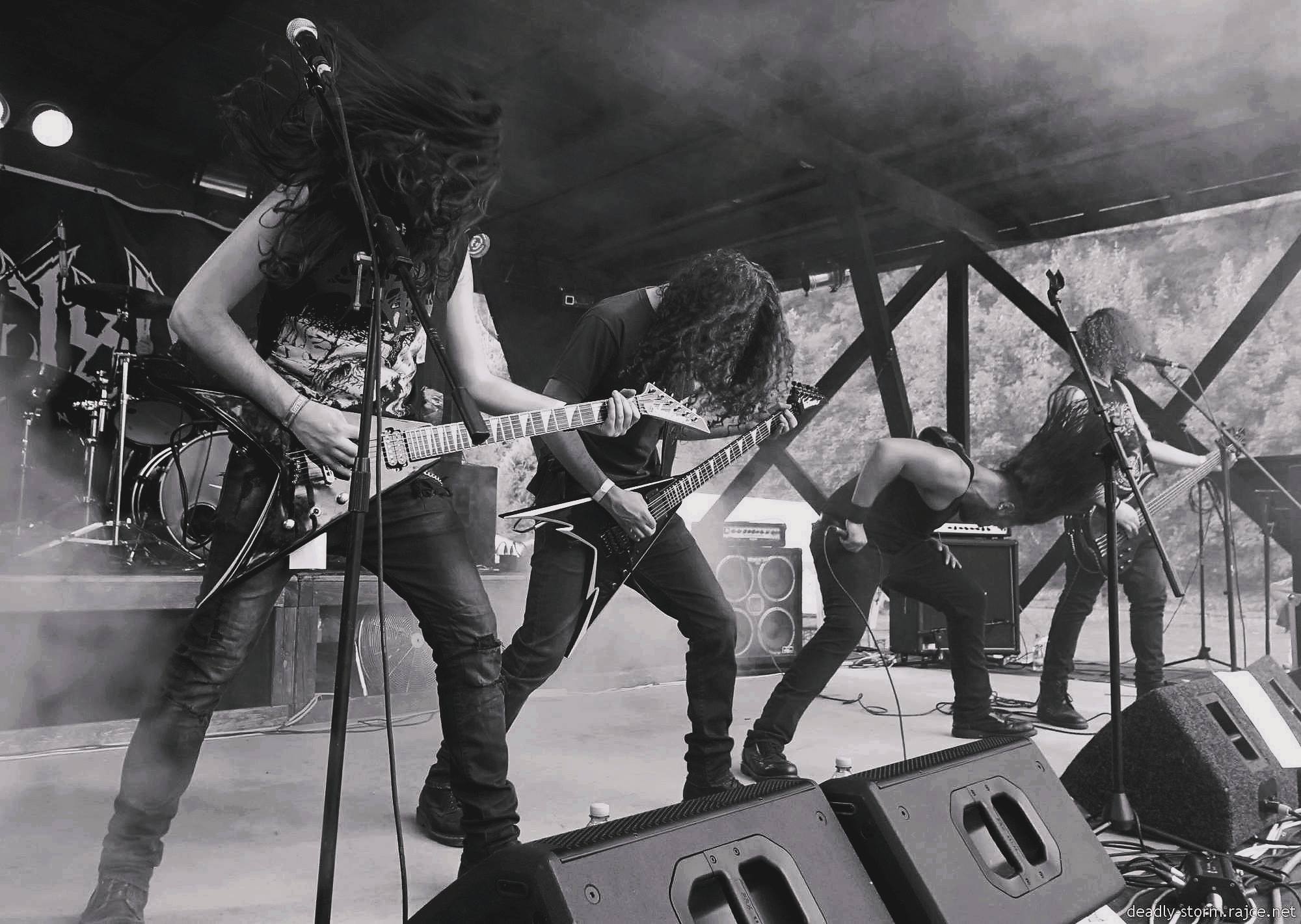
Forged in the scorching fires of Maracaibo, Venezuela in 2014 from the ashes of a band called Daemonhorn, but currently located in Colombia, old school Black Metal horde Theurgia are among us to blast pure hatred and violence with the release of their debut full-length album, titled Transformation. Recorded at Fenix Estudio in Barranquilla, Colombia, mixed and mastered at Dae Home Studio, and featuring an ominous album art created by John Quevedo Janssens (with the art in the digital edition being designed by the band’s own vocalist and guitarist Daemonae), Transformation brings all elements that make traditional Black Metal so compelling and menacing, helping the band carve their name in the history of underground South American extreme music.
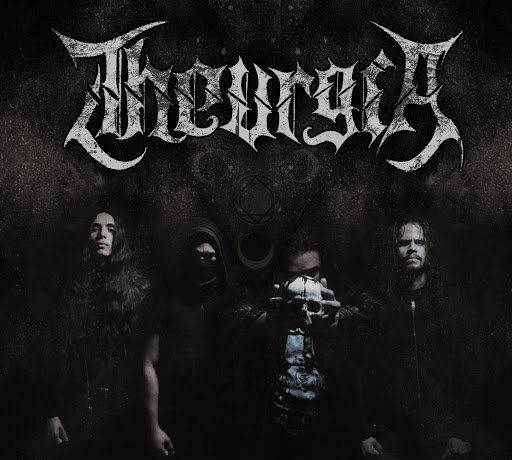
The word “Theurgia” is the Lesser Key of Solomon (also known as Clavicula Salomonis Regis) called “Ars Theurgia Goetia”, the invocation of 31 demonic entities (those being emperors, dukes, kings and princes) with special characteristics. With such an imposing name, the music by Theurgia couldn’t sound more perturbing and dense than what they offer us in Transformation, with their lyrics talking about important topics such as general philosophy and war (in full gear). In the 40 minutes of visceral, disturbing music of the album, the band comprised of lead singer and guitarist Daemonae, guitarist Mortum P., bassist Teuterastus and drummer Hellbeats deliver an enraged message to the world, stating that darkness is upon us and there’s nothing we can do to avoid our grievous fate. In other words, if you’re searching for high-end raw old school extreme music or even the perfect soundtrack to the apocalypse, Transformation has exactly what you need to enfold your darkest and most villainous thoughts.
An intro directly from the pits of hell, titled The Torch ov Creation, announces devastation is about to break loose in ILV (The Verb of Waters), which begins in a doom-ish mode until Daemonae starts to fire his blackened growls while Hellbeats lives up to his own moniker on drums, with the music gradually evolving to raw and furious old school Black Metal. If that solid start is not heavy enough for you, the title-track Transformation presents the Venezuelan quartet on their most menacing beast mode, with Mortum P. delivering truly infernal riffs that effectively complement the demented drumming by Helbeats. Put differently, this full-bodied ode to darkness will offer your ears a chaotic havoc of Black Metal sounds led by the aggressive gnarls by Daemonae.
Transmutation (Of Synesthetic Formula) brings forward more of the band’s evil and obscure sounds, with Daemonae vociferating like a demonic entity while Teuterastus and Hellbeats threaten us all with their rumbling instruments, disturbing our senses until the songs climatic ending. Then we have My Oeneric Dreams, a short, ominous bridge to the visceral Procesio IV – Monotonous Chant, another song that begins in a Doom Metal fashion before exploding into a haunting feast of Black and Death Metal. This is a top-notch blackened aria where Hellbeats sets fire to the musicality with his drums, while Mortum P. distils his sulfuric riffs mercilessly. If you’re a fan of vile Blackened Death Metal, this song is simply tailored for your avid inner demon.
There’s no time to breathe with an onrush of crushing extreme music named Procesio V – Dolorvm, presenting an imposing sonority generated by the mesmerizing Black Metal riffs by Mortum P. and the unearthly bass by Teuterastus; followed by Procesio VI – Mea Spíritus in Opium (the creation of our souls before apparent orthodox existence), where the band gets to a truly demented level, delivering high dosages of putrid gnarls, devilish riffs and blast beats, resulting in a scathing descend into the crypts of Hades with Theurgia, therefore ending the album on a high note. And as a bonus track to the physical version of the album we have their cover version for Dissection’s Retribution – Storm of the Light’s Bane(check the original version HERE), taken from the tribute album “In Memory of Jon Nödtveidt – A Tribute to Dissection”, bringing all the fury of the original song by Dissection with Theurgia’s own perverse twist.
Enjoy this concept album about how urban life can separate us from reality and how at the same time it gives us freedom to cross its boundaries, all enfolded by first-class blackened music made in Poland.
“Biesy were born out of everyday working, urban and monotonous realities. The project explores how urban concrete life can separate you from reality, but at the same time enables you to cross its borders. This is not the place for faith – there is no time nor will. During the night people go astray and willingly drown among the masses on the streets. In the morning they fall down to create a passage for everything that is wonderfully common and hideously sincere. However, it is not certain if they even left the room.”
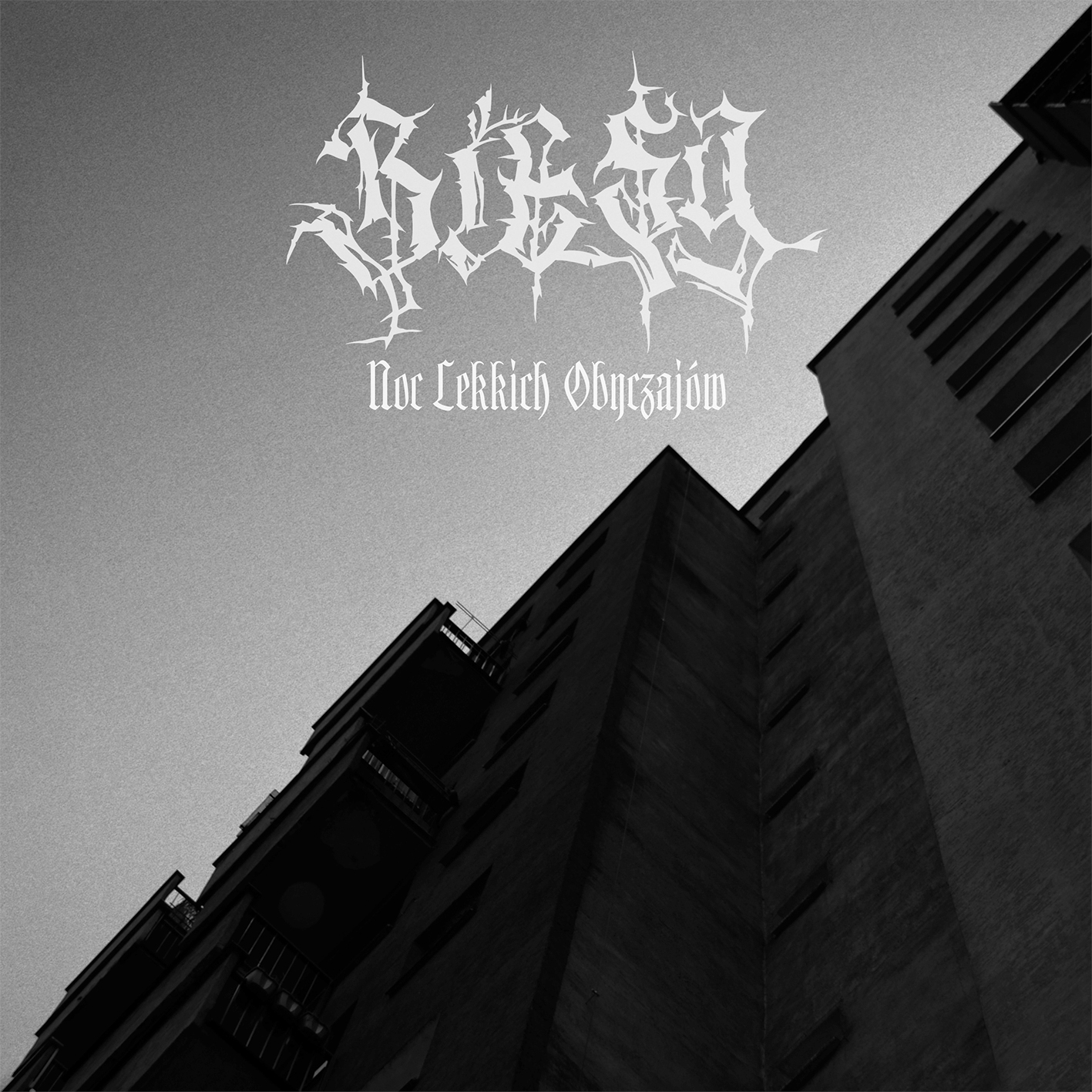
Those poetic words work as a classy introduction to the core essence of Black/Death Metal act Biesy, a brand new project formed in 2014 in Cracow, Poland by lead singer Stawrogin, guitarist, bassist, songwriter and lyricist PR, and drummer Maciej Pelczar. Biesy translates to “fiends” or “demons” from Polish, and from that you can imagine how dark their music should sound in their debut full-length release Noc Lekkich Obyczajów, or “night of weak morals” in English, a concept album about how urban life can separate us from reality and how at the same time it gives us freedom to cross its boundaries, as mentioned above, all enfolded by an ominous and depressive form of extreme music not recommended for the lighthearted. Add to that the concrete gray layout designed by PR himself together with Mentalporn, the menacing logo created by Ihasan, and the fact that all songs are entirely sung (or maybe I should say growled or gnarled) in Polish, and there you have a distinct, full-bodied Extreme Metal ode to everything we love and hate in our concrete jungles.
In the opening track, titled Każdego Dnia (which should translate as “every day”), ominous sounds grow in intensity until the music morphs into the most vile form of Blackened Doom you can think of, with Stawrogin sounding truly demonic on vocals while PR does an amazing job with his mesmerizing guitar lines, resulting in a cold and beautiful display of extreme music that darkly flows into a climatic ending. In W Krew (which should mean something like “in blood”), the power trio switches to a more demolishing mode, blasting a Stygian fusion of Black and Death Metal led by Maciej, who showcases all his skills by delivering both rhythmic and sluggish punches as well as infernal blast beats. In the end, it becomes impossible not to have your heart darkened by this superb hymn. And it seems like peace and happiness are definitely two items you won’t find in the music by Biesy, which is exactly the case in Powroty (or “returns” in English), even more doomed than the two previous songs and with the vociferations by Stawrogin being extremely menacing. Put differently, it’s unhappy, melancholic and visceral Blackened Doom tailored for headbanging until you crack your neck in half.
The second batch of somber sounds by Biesy begins with Czerń Nas Prosi (or “blackness calls us”), the shortest of all tracks, feeling like a satanic invocation with Maciej firing some traditional Doom Metal beats while PR sounds hellish on both guitar and bass, not to mention Stawrogin’s evil gnarls; followed by Rzucony W Przestrzeń (which translates as “thrown into space”), the longest and most obscure of all songs, starting with a deep, enraged roar by Stawrogin. Not only this is a lesson in Extreme Metal where PR is insanely dark on guitars, but its heaviness keeps growing and growing until after around four minutes there’s a creepy intermission that goes on for another four minutes until the trio returns with all their fury and malignancy, with the vocal parts getting more deranged and evil, ending in the most obscure way possible. And if you think you’re safe from Biesy after all that darkness, you’re absolutely wrong, as they have one final onslaught of Black, Death and Doom Metal to disturb your mind and soul, the title-track Noc Lekkich Obyczajów, where Maciej takes his already devilish drumming to a whole new level of dementia accompanied by the lancinating riffs by PR. This fantastic album of extreme music couldn’t have ended in a better way than this, I must say.
In summary, it doesn’t matter if you speak fluent Polish or if you don’t know a single word in this distinct language, Noc Lekkich Obyczajów (which is available for a full stream on YouTube) is definitely worth a shot. What Biesy did in the entire album, uniting the aggressive and damned sounds of Death, Black and Doom Metal with the disorders and unpredictability of life in the city in a sharp and bold manner, deserves our total recognition and respect. You can buy your copy of Noc Lekkich Obyczajów on BandCamp, at the Third Eye Temple webshop or at Discogs, and after finally having the album on your hands, you can add the perfect soundtrack to spend your deranged nights in the city.
Best moments of the album: W Krew and Noc Lekkich Obyczajów.
Worst moments of the album: None.
Released in 2017 Third Eye Temple
Track listing 1. Każdego Dnia 5:08
2. W Krew 6:38
3. Powroty 7:06
4. Czerń Nas Prosi 3:51
5. Rzucony W Przestrzeń 11:29
6. Noc Lekkich Obyczajów 7:59
Band members Stawrogin – vocals
PR – guitars, bass
Maciej Pelczar – drums
Enjoy the third and final installment of the sagaof the Atai in the form of a thirteen-song Sci-Fi opera of Symphonic and Progressive Black Metal.
After the releases of the first and second parts of a trilogy about the complex saga of the Atai (ancient architects), who aid in the propagation of sentient life throughout the multi-verse, those being the full length albums Dimensions, from 2014, and The Exile, from 2016, American Symphonic/Progressive Black Metal warriors Rapheumets Well return now in 2017 with the third and final installment of this musical saga, Enders Door, a thirteen-song science fantasy opera in the form of Symphonic Metal. Although this relentless North Carolina-based squad suffered a few lineup changes from their previous release, such as the departure of lead singer Tripp King (being replaced by the insanely talented growler Jeb Laird), their music remains bold, visceral and ominous, perfect to give a climatic ending to such compelling story.
And do you want to know what happens in Enders Door while the entire band is kicking some serious ass with their flammable instruments? Well, this is what Rapheumets Well will tell you: in the fifth era of the Avomenian Empire, amidst the planetary ruins of Vaath, a rogue traveler would discover an artifact that would forever change his place in the cosmos. Upon arriving to retrieve the artifact, it became apparent that Eryos’ brother Nathyiem would never make it to their arranged meeting point. In departing from the planet Vaath, Eryos received a distress signal from his brother’s ship, coming from an uncharted planet. Upon arriving, he found an odd world inhabited by a mysterious species called the Dreth led by lecherous matriarch named Eishar. It is here that he would uncover a faced-door, an inter-dimensional gateway to the Ender.
In the opening track, titled The Traveler, we face an eerie, cinematic start to the album, transporting us to the world of Rapheumets Well by blending the finesse of keyboards and choir with devastating blast beats, before Jeb begins growling like a beast; followed by Distress on the Aberrant Planet, where the brutality led by the band’s mastermind Joshua “Nasaru” Ward on drums is effectively complemented by the keyboards by Annette Greene, while guitarists Brett Lee and Hunter Ross make sure they add the world “metal” to the music. The Autogenous Extinction offers the listener more demolishing, ominous sounds crafted by this unstoppable band, resulting in high-end Symphonic Black Metal with hints of Blackened Death Metal for admirers of the music by Dimmu Borgir and Behemoth, with Annette bringing balance to the sonic havoc with her smooth vocals. And in Secrets of the Demigods we’re treated to another great “duel” between Annette and Joshua, a true clash of delicate vocals and bestial beats, all embraced by a dark and dense background enhanced by classic guitar riffs and solos.
Then we have one of the longest and most complex of all tracks, Lechery Brought the Darkness, with its semi-acoustic intro suddenly exploding into sheer Symphonic Black Metal, with the paradox of voices between Annette with her angelic vocals and Jeb with his rabid gnarls sounding incredible from start to finish; and the title-track Enders Door, a fantastic tune showcasing a phantasmagorical background, extreme violence flowing form Joshua’s drums, and crushing guitar lines by both Brett and Hunter, perfectly depicting the traveler’s quest in the form of top-tier metal. In Prisoner of the Rift, they keep a menacing aura upon us with a fusion of Symphonic Metal with acoustic and even folk elements, creating a unique sonority led by the gentle voice of Annette, whereas The Diminished Strategist kicks off in full force, being an amazing representation of modern and intense Black Metal. Furthermore, the song’s keyboards sound mesmerizing when combined with the clean vocals by both Annette and Joshua, with the huge amount of progressiveness added to the music amidst all the sonic chaos going on resulting in an eccentric music voyage.
Nastarian Waltz works as a whimsical bridge to the imposing and epic Ghost Walkers Exodus, where Joshua continues to impress on drums with his nonstop beats and fills in a flawless combination of progressiveness, symphonic elements and the most devastating form of Black Metal. Put differently, this song alone sounds so complete it is already worth the investment on the album. On the other hand, Killing the Colossus, despite being another solid creation by Rapheumets Well, is not as gripping as the other songs of the album. Its guitars and keyboards in a dark sync help boost the song’s taste though, not to mention the obscure vociferations by Jeb. Lastly, after a piano-guided atmospheric bridge titled Eishar’s Lament, it’s time for the closing track of the album, the sinister Unveiling the Sapient, with Joshua once again pulverizing everything and everyone with his drums while Brett and Hunter deliver some Technical Death Metal-inspired guitar lines and solos, culminating in a sensational conclusion for this awesome Sci-Fi story.
What are you waiting for to dive into the metallic world of Rapheumets Well? You can buy your copy of Enders Door at the Test Your Metal Records’ BandCamp or Big Cartel, as well as on iTunes or Amazon, and remember you can also get online the first two installments of this heavy and gripping trilogy, such as HERE and HERE. I honestly don’t know what’s next for Rapheumets Well, if they’ll start a new trilogy with a whole different story, if they’ll release a regular album, or maybe even release a prequel to this existing trilogy. One thing is certain: no matter what their next step is, we can rest assured Joshua and his bandmates will certainly blow our minds once again with their multi-layered metal music.
Best moments of the album: Distress on the Aberrant Planet, Enders Door and Ghost Walkers Exodus.
Worst moments of the album:Killing the Colossus.
Released in 2017 Test Your Metal Records
Track listing 1. The Traveler 4:39
2. Distress on the Aberrant Planet 3:57
3. The Autogenous Extinction 4:45
4. Secrets of the Demigods 4:40
5. Lechery Brought the Darkness 6:39
6. Enders Door 6:35
7. Prisoner of the Rift 2:58
8. The Diminished Strategist 5:36
9. Nastarian Waltz 1:13
10. Ghost Walkers Exodus 5:41
11. Killing the Colossus 5:58
12. Eishar’s Lament 1:18
13. Unveiling the Sapient 7:21
Band members Jeb Laird – lead vocals
Annette Greene – clean vocals, keyboards
Brett Lee – guitar
Hunter Ross – guitar
Joshua “Nasaru” Ward – drums, clean vocals
Fast and intricate riffs, poetic lyrics, a sensational new drummer and, above all, the return of Matt’s trademark screams. That’s the formula for best metal album of the year.
Finally, after two somewhat controversial albums (the technically excellent but not unanimous Vengeance Falls, from 2013, and the extremely tiresome Silence In The Snow, from 2015), Orlando-based Heavy Metal fighters Trivium are back on track with what’s probably going to be the best metal album for most critics and fans worldwide, the sharp, dynamic and vibrant The Sin and the Sentence. This amazing release (the eight studio album in their solid career) features everything you learned to love in the music by Trivium, such as fast and intricate riffs, poetic lyrics and, above all, the return of the band’s mastermind Matt Heafy’s screaming vocals, by far the most important element that makes The Sin and the Sentence a million light-years better than Silence In The Snow.
Not only Matt’s enraged growls are back, but it seems that the band has at long last found the perfect drummer for their music, the talented Alex Bent (Battlecross, Brain Drill, Dragonlord), who replaced drummer Paul Wandtke, and as soon as you hit play you’ll be able to clearly see the humongous difference Alex makes to their sound. In addition, another interesting thing in The Sin and the Sentence is that the album wasn’t going to be called this way if it wasn’t for the cover art and design done by Matt’s wife, Ashley Heafy, with whom he’s married since January 2010. In a recent interview, Matt stated that the working title for the album was The Revanchist and that the album was going to have gold and neon colors; however, those plans were changed once Ashley presented the band with symbols for each accompanying song, and from there The Sin and the Sentence was born.
The opening track, The Sin and the Sentence, kicks off in full force, with newcomer Alex showing us all the wonders a high-skilled drummer can do to a band. This born-to-be-a-classic tune is extremely addictive and as heavy as hell, with an inspired (and recovered) Matt simply kicking fuckin’ ass on vocals; and it seems that no matter how their music sounds, Matt & Co. definitely know how to craft beautiful lyrics (“I saw the dagger eyes staring back at me / I knew I’d never have a chance to bleed / Guilty, but in the sight of fallen men / They bury you before you speak / (The sin and the sentence)”). Then blending Death, Groove, Progressive and even Black Metal in an aggressive but very melodic manner, Beyond Oblivion, a technical tune that lives up to the band’s legacy, showcases fun, uprising backing vocals in sync with the rumbling sound of the bass by Paolo Gregoletto, not to mention their once again hypnotizing lyrics (“These shadows sleep so soundly / Appalled, he now averts his eyes / Disgraced, he felt so empty / Entrusting us with our demise”). And Other Worlds feels closer to what they did in the albums In Waves and Silence in the Snow by focusing on the clean vocals by Matt, while Corey Beaulieu and Matt deliver sharp and very harmonious guitar lines and solos, presenting hints of modern Hard Rock in its rhythm.
The second single of the album, The Heart from Your Hate, is another great example of how Trivium can adapt from being a truly heavy machine to a more radio-friendly band, presenting a catchy chorus that goes along really well with the song’s main riff; whereas Betrayer can be considered the most visceral and electrifying of all tracks in the album, a full-bodied, intricate composition that brings several elements from the band’s first (and more ferocious) albums. Furthermore, do you also think the guitars sound a lot like the classic riffage by Black Metal titans Emperor, one of Matt’s favorite bands of all time? Anyway, in The Wretchedness Inside, a song to bang your head like a maniac, Paolo sounds thunderous on bass, with the song’s overall rhythm reminding me of the most recent albums by Slipknot mixed with Trivium’s In Waves sounding. And, as usual, Matt provides us another blast of top-notch lyrics (“Submerged in dirt but it was never enough / To quell the fire in the back of my lungs / My bones are aching and my head is a mess / They said to run but I’m obsessed with the madness”). As a side note, this song was actually taken from a demo Matt ghostwrote for a different band in 2014; the song was never used though, so Trivium simply re-recorded it for The Sin and the Sentence. The following track, titled Endless Night, feels like some songs from Vengeance Falls, again with a higher focus on Matt’s clean vocals, also bringing hints of Hard Rock to their heavy sonority. Moreover, the sound of bass guitar, which by the way is simply fantastic the whole album, ends up boosting the impact of this specific tune considerably.
Sever the Hand is a first-class composition that can be divided in two distinct pieces, the first presenting a more melodic, smoother musicality, while the second brings all Trivium’s fury, in special the precise beats by Alex, the demonic riffage by Matt and Corey, and Matt’s sick growling. More obscure but still heavy and metallic, Beauty in the Sorrow displays gripping guitars by Matt and Corey (as well as one of the best guitar solos of the whole album), again bringing hints of traditional Black Metal in its riffs; whereas The Revanchist, one of Trivium’s most progressive songs of their past few albums and the longest in The Sin and the Sentence, brings forward powerful, metallic bass lines that will punch you in the head while Matt tells the story in a solid and entertaining manner, not to mention how Alex yet again steals the spotlight with his bestial, rhythmic drumming. Lastly, Thrown into the Fire is a song that showcases all elements from most of Trivium’s phases, not to mention how superb Matt’s screams sound. With the insane beats by Alex dictating the song’s rhythm, the final result is furious and harmonious just the way we love it, ending this awesome album in a brutal, vile and piercing way.
After listening to The Sin and the Sentence, do you also agree with me it will most probably be the best metal album of 2017? Let’s face it, there are tons of amazing albums launched this year, like the new ones from Kreator, Mastodon and Accept, but the new installment by Trivium is by far the most complete, creative and exciting of all (at least for me). Well, even if you think another album (or maybe albums) is better than The Sin and the Sentence, it’s still worth the investment, so go grab your favorite version of it at the Warner Music webstore, and don’t miss Matt & Co. when they take your city by storm in the coming months. And, obviously, let’s hope the band keeps the momentum going for years to come in the same awesome vein as they just delivered us all with The Sin and the Sentence.
Best moments of the album: The Sin and the Sentence, Betrayer, Sever the Hand and Thrown into the Fire.
Worst moments of the album: None.
Released in 2017 Roadrunner Records
Track listing 1. The Sin and the Sentence 6:23
2. Beyond Oblivion 5:17
3. Other Worlds 4:50
4. The Heart from Your Hate 4:04
5. Betrayer 5:27
6. The Wretchedness Inside 5:32
7. Endless Night 3:38
8. Sever the Hand 5:26
9. Beauty in the Sorrow 4:31
10. The Revanchist 7:17
11. Thrown into the Fire 5:29
Japanese Edition bonus track 12. Pillars of Serpents ’17 (re-recorded version) 5:03
Band members Matt Heafy – lead vocals, guitar
Corey Beaulieu – guitar, backing vocals
Paolo Gregoletto – bass guitar, backing vocals
Alex Bent – drums, percussion
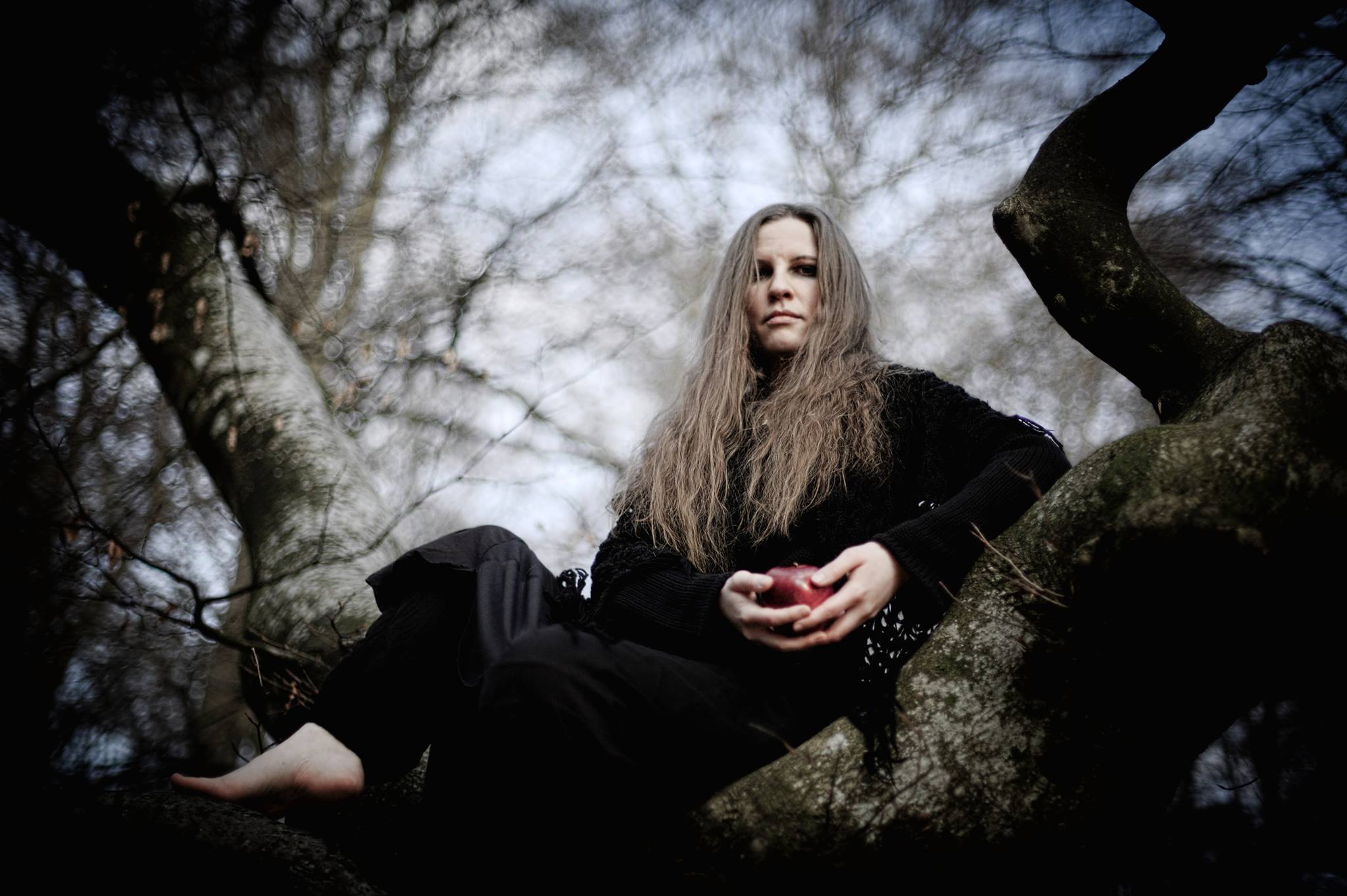
The month of November in the Northern Hemisphere is always a synonym to colder temperatures and darker days, a sign that winter is coming and that all the happiness and warmth of the summer are long gone and will take even longer to return. Having said that, there’s nothing better than listening to some old school, menacing Scandinavian Black Metal to “celebrate” the Stygian season that’s about to begin, especially if it’s the Black Metal crafted by our metal chick this month, the multi-talented Swedish Valkyrie known as Dagny Susanne, the mastermind behind the top-notch extreme music project Nachtlieder. By the way, Nachtlieder is German for “night songs” or “songs of the night”. Do I need to say more?
Born on September 9, 1986 in Kiruna, the northernmost town in Sweden, situated in the province of Lapland, but currently residing in the multi-cultural Swedish city of Gothenburg where she moved about a decade ago, Dagny Susanne (whose real full name is Karin Dagny Susanne Hansson) mentioned she never had any friends who were into heavy music nor could buy any albums in her hometown because there wasn’t a record store there at that time, being “forced” to download music using Napster with a modem, which obviously made her discovery of metal painfully slow. Furthermore, growing up in Kiruna affected her personality and the way she currently sees things both in good and bad ways, but her interest in metal, in meeting musicians and starting a band motivated her to move to Gothenburg. However, nowadays Dagny feels a little nostalgic when talking about her beloved Kiruna, saying that not only it’s a beautiful and serene place, but it also inspires you to work, clearing your head and putting you in a good state of mind due to its calmness and distance from bigger cities like Gothenburg and Stockholm. For instance, just to give you an idea of how isolated Kiruna is, Luleå, the biggest town in the same region, is nothing more, nothing less than three hours away from it.
Since 2008, Dagny has been embellishing the world of extreme music with her Black Metal outlet Nachtlieder, being responsible for the songwriting, the lyrics, all vocal parts and pretty much all other instruments except for the drums, played in almost all her releases by her longtime friend Martrum (also known as Dödsdyrk, from bands such as Minion and Wicked). After the release of two demos in 2009 and a promo album in 2010, Dagny and her Nachtlieder became a much bolder and intense entity after unleashing upon humanity the full-length albums Nachtlieder, in 2013, and more recently The Female of the Species, in 2015, with the latter having the Biblical character of Eve, the female of the species, as the central character in the album’s narrative as mentioned in our review for the album. However, the original idea of the album was taken from the book “The Female of the Species”, by American writer Joyce Carol Oates, a collection of novellas about women committing different acts of violence for various reasons, slightly changing to the narrative about Eve after Dagny began to reference the phenomenon of “Satanic feminism” where Satan, a symbol for liberation, is also used as a feminist icon in her lyrics. In addition, Dagny said that, as she used to work in a public library, she reads a lot and that has a significant influence on her lyrics (but not on her music, thought), starting with small text fragments before coming up with what the lyrics should be about.
If you want to take a good listen at the music by Dagny and her Nachtlieder, I highly recommend you go to BandCamp, YouTube or Spotify to do so, being suddenly embraced by her visceral Black Metal such as in the excellent songs Eve, Beyond Death, Leave the View To the Rats and A Meager Escapism. The only “issue” with Natchlieder is that you won’t be able to find any live material or footage online, as Dagny hasn’t been able to form a full-bodied band yet. She obviously wants to perform live some time, but there are a few barriers to that such as the availability of musicians in her circle of friends that would be willing to play her music, and if those musicians would be reliable enough to replicate her music to an acceptable level to her.
Prior to becoming Nachtlieder, our Swedish black metaller was the bass player for Gothenburg-based Death/Black/Thrash Metal band Wicked from 2006 to 2010, having recorded with them a demo titled Chaos in 2007, the single Gospel of Sickness in 2009 and the split album Abominations, Chaos and Bestial Warfare in 2009 together with the bands Adokhsiny, Land of Hate, Надимач and Wargoatcult. She mentioned that she learned a lot from that time as it was her first extreme band, in special about arrangements and the role of the bass guitar in a band. The band unfortunately disbanded after their lead singer moved out of town with his family, but all three members are still friends and try to meet as much as possible whenever they’re in the same city. Apart from Wicked and obviously Nachtlieder, you can find Dagny in a couple of bands and projects as a guest musician, being the bassist and guitarist for the 2016 album Winds of Transilvania, by American/Swedish Black Metal project Nattsvargr (led by American vocalist Noctir); and doing some vocals and violin for a German Ambient Black/Doom Metal band named Black Autumn.
Dagny also has a very interesting (and obviously strong) connection with Black Metal from her homeland, having discovered the genre in her teens and consequently listening to Swedish bands for hours and hours, in special her favorite of all, Dissection. For instance, she mentioned that Dissection’s first gig after guitarist, vocalist and main songwriter Jon Nödtveidt (R.I.P.) got out of prison was the first big concert she ever went to. When asked about the general concept of cold and dark winter days being the reason why Scandinavian Metal is so unique, our Swedish diva said that there are of course bands that succeeded in portraying the extreme conditions and contrasts that exist in the northern parts of Scandinavia through their music, but that you can also see a significant difference between the metal scene in Norway, Sweden and Finland. Furthermore, when asked what defines Black Metal as a genre, Dagny said that when she wrote her bachelor in musicology about Black Metal she tried to identify the elements that define the music, finding that certain intervals were used both in chord progressions and melodies, therefore making Black Metal a music style for her no matter what the lyrical content is. For example, she said that if Black Metal is all about Satanism as several people think, then a band like Immortal, one of the biggest and most influential exponents of the genre, wouldn’t be Black Metal.
This slideshow requires JavaScript.
As usual, I love to know about our metal girls’ opinions about women and sexism in the metal universe, and Dagny has a strong position about those topics, especially for playing a music style vastly dominated by men. First of all, she mentioned that gender isn’t the only thing that matters, citing other details such as age, profession, place of birth and residence and ethnicity, among others, as reasons why different people doing the exact same thing will certainly receive very distinct feedback from the society. However, she said she has already faced some not-so-subtle sexist comments directly to her face such as “chicks can’t play”, as well as the feeling of not being fully respected by guys whenever she was the only woman in the group. In addition, she said that although she doesn’t know for sure why the number of one-woman Black Metal bands is extremely low compared to one-man Black Metal projects, she feels that it might be due to the different networks between men and women and the conscious and subconscious differences in social sex. “From the day we’re born we’re not encouraged to do the same things and this includes the music we should listen to and perform and the instruments we should play”, said Dagny. Also, she thinks the well-established expression “’female-fronted metal” (which I confess I end up using quite often i my reviews and discussions) doesn’t really make sense at all, like the term “female vocals” instead of “clean vocals” when the singer is not a man, and that applies to Nachtlieder as very few people would associate those expressions with the type of music she plays.
As any musician in our modern-day society, Dagny also has to deal with illegal downloads of her music, but she doesn’t see those as a huge threat to music in general as many others do. She said that the biggest trouble for artists like her concerning illegal downloading is that they can’t keep track of their listeners, and knowing who her listeners are and that there are people out there who appreciate her music is always a boost to her creative process. She thinks that people who can afford it should prioritize paying for their music consumption, and the ones who can’t pay for it should at least be part of an informal “marketing campaign” by sharing the bands’ Facebook and BandCamp pages, leaving positive comments on YouTube, among other small but meaningful acts. The only thing that really bothers her in this case is when an album leaks before the release date, as she finds that really disrespectful towards the hardworking labels and artists. Furthermore, Dagny also considers the way music is shared by fans on the internet extremely positive for independent artists like herself, saying that for example fan initiatives like the Facebook community Death Metal Girls and the YouTube series The Female Vocalists of Extreme Music are great options for headbangers who want to broaden their knowledge of female artists in metal.
Lastly, one might think that a musician like Dagny, coming from the northernmost part of Sweden and playing the ominous Black Metal by Nachtlieder, must draw most or all of her inspiration in the night, but in reality that’s not what happens to her during her creative process. Dagny said she’s inspired by her instrument and what she’s playing at the moment, with the calm and relaxed feeling from the middle of the night being of course something she loves but that due to her working schedule is not something she can fully enjoy anymore. For instance, one of my favorite songs from The Female of the Species, the fantastic Nightfall, was written at night and had parts of its lyrics inspired by the first part in the Arnold Schoenberg opera Pierrot Lunaire, also known as “Moonstruck Pierrot”. I guess everyone reading this tribute to Dagny has already gotten “moondrunk” in life, feeling dizzy or lightheaded after staying awake for an entire night, but of course very few of us are capable of delivering such vibrant and captivating music by ourselves like this high-skilled woman who left her hometown, the distant city of Kiruna, to conquer the world of extreme music with her undisputed, raw and totally awesome Black Metal.
“My own purpose with feminism is not to blame the trouble in the world on a specific group of people, but to raise the questions. Make people think about how they treat others and why. It’s all about recognizing human value, in the metal scene, but most of all outside of it. I’m certainly responsible too and no one is without flaws. We’re all products of the societies we live in.” – Dagny Susanne
Expanding upon their Black Metal roots by embracing the ferocity of the most mutated and cursed Death Metal, this Spanish horde brings forth a violent and ferocious one-way journey into darkness with their brand new release.
“Time is an ever open wound, that never hurts the same twice.”
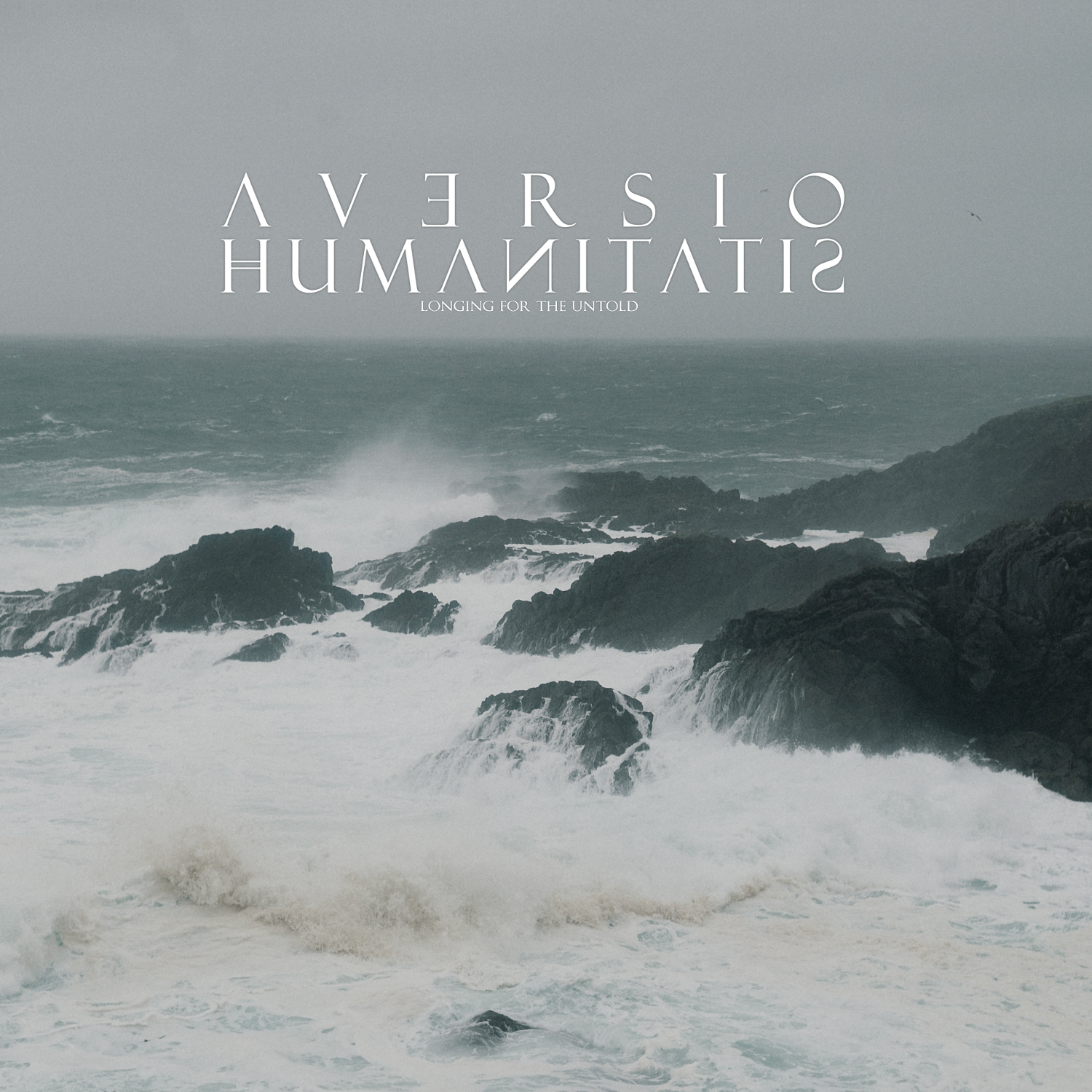
Since their inception in 2010 in the city of Madrid by a core and unchanged trio of mysterious locals, Spanish Black/Death Metal horde Aversio Humanitatis(Latin for “the loathing humanity”) has been slowly morphing into a beast of implausible proportions and of ungraspable intents, as they began to expand upon their Black Metal roots by embracing the ferocity of the most mutated and cursed Death Metal. This transcendental and abhorrent metamorphosis into otherworldly sonic tyrant fully sublimated in their 2017 EP Longing for the Untold, in which Aversio Humanitatis went from being a purely methodical and vaguely technical Black Metal band in the vein of Emperor, Satyricon and Abigor, to becoming something completely undefinable, shaped by the ever so apparent lineaments of an unquenchable black hole, a beast capable of harnessing the power of collapsing stars and of the very depths of Hades.
Originally released on CD in Spain only in early 2017, Longing for the Untold is by far the boldest and most Stygian opus by this idiosyncratic Spanish entity, surpassing their 2011 debut full-length album Abandonment Ritual in terms of heaviness, obscurity, chaos and aggressiveness. Now re-packaged with three bonus tracks from their 2013 split Three Ways of Consciousness (with Venezuelan/Chilean Black Metal act Selbst and Spanish Black Metal act Nihil) and with a new incredible artwork, Longing for the Untold brings forward a colossal behemoth of technically intimidating and sonically imposing Progressive Black Metal that lunges forth toward the listener with crushing force, levitating out of solid darkness. More than just an album, Longing for the Untold represents a place and time where the power of sound literally devours the senses, turning perception into a smoldering and swarming void of sensorial awe and of transcendental sonic disintegration.
The sensational title-track Longing for the Untold presents the fury of old school Black Metal mixed with atmospheric and menacing sounds, with vocalist and bassist A.M.’s dark guttural growls being spot-on, therefore enhancing the song’s obscurity and its wicked lyrics (“Time is an ever open wound / that never hurts the same twice / Twisted shards created by our will / shall open the flesh / in ways that may be poetry, or may be mundane / Since the shadow of our self is always / longer than our height / Since the pride of our self is always / shorter than our pain”), also showcasing truly infernal blast beast by drummer J.H. Prison of Shattered Glass feels a lot more doom-ish than the opening track, with A.M. and guitarist S.D. delivering pure evil through their strings. In other words, this is a lesson in Blackened Doom by this excellent Spanish entity, where the devilish background sounds, the ominous growls by A.M. and the sluggish beats by J.H. end up generating a sulfuric and disturbing ambience altogether, ending in a beautiful, Stygian way; whereas The Ever Shifting Path gets back to a more perturbing and belligerent sonority, with the Black Metal-inspired drumming by J.H. together with the hellish vociferations by A.M. being the main elements in this fantastic Extreme Metal aria, becoming even more impactful halfway through it.
Longing for the Untold BlackSeed Productions Edition
Closing this top-tier feast of obscure and extreme music we have the eerie Advent of the Inescapable, starting with an atmospheric, creepy intro before exploding into absolute hatred in the form of Black Metal, and that perturbing feeling goes on until the music fades into sheer darkness. Moreover, pay good attention to its lyrics, which are beyond perfect for the music played (“Transcend a fraudulent reality – / let fear and pain penetrate and go through / Deconstruct your being – / resign all perishable aspirations / Dissociation from all that surrounds you – / become an impassive entity / Accept your purpose in this world – / you are here to destroy and suffer”). As aforementioned, this new version of Longing for the Untold also contains three bonus tracks, all from their 2013 split Three Ways of Consciousness (Spears of Unlight, Psalms of the Wandering andShrine of Involution), which add a 0.5 to the album’s overall score by offering more of Aversio Humanitatis’ undisputed fusion of Atmospheric Black Metal with Doom Metal.
After paying a visit to Aversio Humanitatis’ Facebook page and YouTube channel to know more about this distinct act hailing from Spain and to get a better taste of their music, I’m sure you’ll promptly search the web for a copy of Longing for the Untold (which by the way can be enjoyed in its entirety HERE, including all bonus tracks). Well, let me tell you that your hunt will be an extremely easy task, as the album is available for purchase at the Sentient Ruin Laboratories’ BandCamp or webstore, at the BlackSeed Productions’ webstore in black vinyl, white vinyl or cassette, on Amazon or at Discogs; as well as at the band’s own BandCamp and at the BlackSeed Productions’ BandCamp or webstore (with or without the bonus tracks). And when you finally have this fantastic album on your hands, get ready for a violent , never-ending and ferocious one-way journey into darkness.
Best moments of the album: Longing for the Untold and The Ever Shifting Path.
Worst moments of the album: None.
Released in 2017 Sentient Ruin Laboratories
Track listing 1. Longing for the Untold 5:04
2. Prison of Shattered Glass 6:06
3. The Ever Shifting Path 5:36
4. Advent of the Inescapable 4:41
Vynil & Tape B-Side bonus tracks 5. Spears of Unlight 4:38
6. Psalms of the Wandering 5:34
7. Shrine of Involution 6:15
Band members A.M. – vocals, bass
S.D. – guitars
J.H. – drums
Live musicians N.H.T. – guitar, vocals
J.C. – bass
In the vast land known as Ezerath, the impending death of a king becomes first-class Progressive Death Metal through the hands of a talented Canadian multi-instrumentalist.
Before you start listening to Overture: The Heir Apparent, the debut full-length album by Canadian Progressive Death Metal act Ezerath, let me tell you that not only this is a one-man project where multi-instrumentalist Jeremy Vocino-Montpetit was responsible for recording all vocal parts (except of course for the female vocals by guest singer Felicia Weinmann) as well as all other instruments and programming, but the album also took three full years to be released between writing, learning how to sing, and learning how to mix and master. In other words, what Jeremy is offering the world of heavy music with his Ezerath is the perfect example of how talent, hard work and a good dosage of creativity, when properly combined, always result in sheer amusement for our ears and minds.
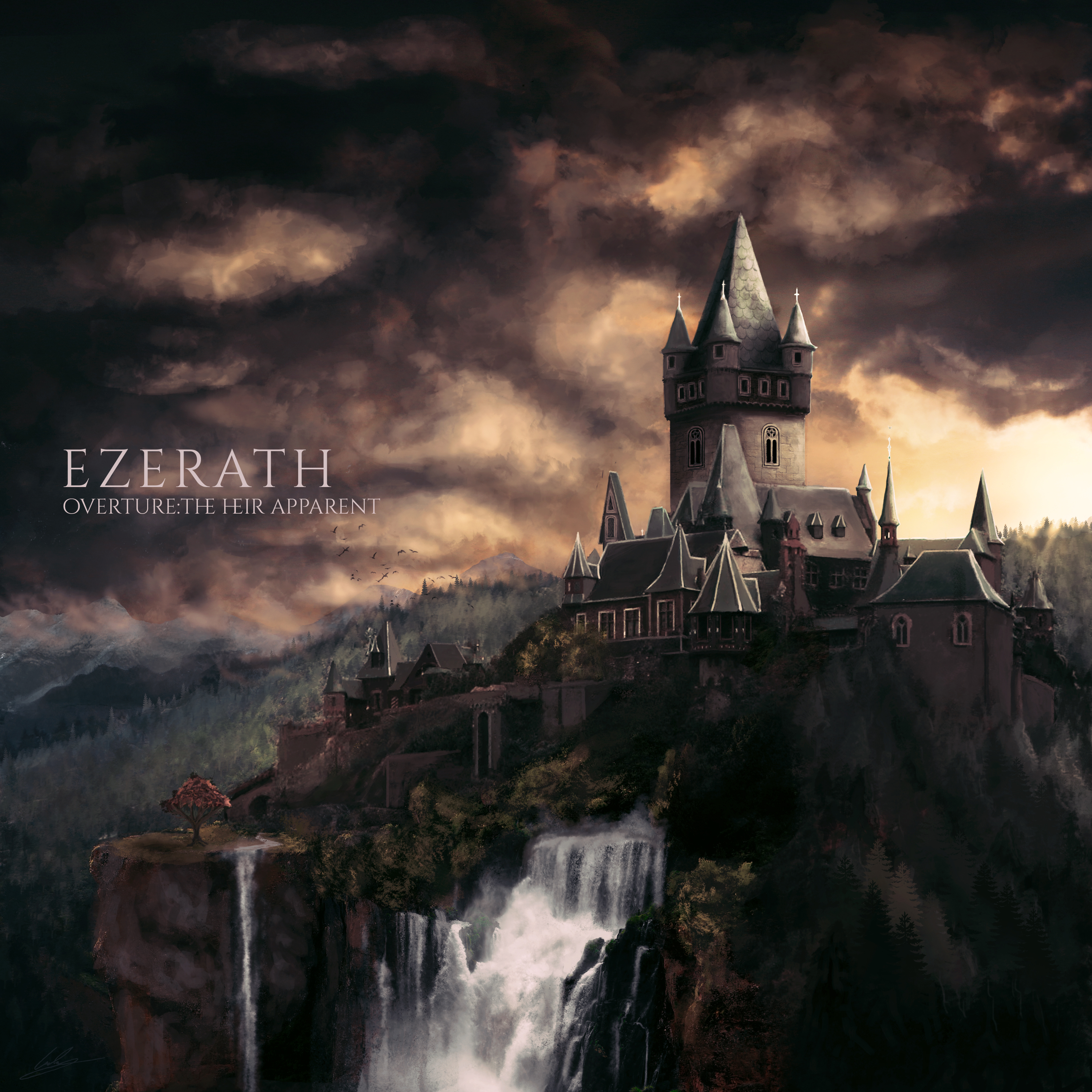
Formed in 2016 in the city of Montreal, Quebec, Ezerath is a project highly recommended for fans of the music by Behemoth, Opeth, Nile, Edge of Sanity, Bloodbath and several other bands that know how to unite extreme music with a gripping concept. Yes, Overture: The Heir Apparent is not just another regular metal album, bringing a full-bodied storyline in the background to support the music. The entire album, which by the way features an elegant artwork by Caelan Stokkermans (from Caelan Stokkermans Arts), is a first person narrative, depicting the thoughts of several main characters immediately before the death of Alton Nayan, the King of Gnara residing in Stonegate Castle, located in the vast land known as Ezerath.
The intro to the opening track, the flammable Temple of the Forsaken, feels like we’re watching a movie or reading a novel, which in the end is Jeremy’s main goal with the album, before he begins blasting a very intricate and melodic form of Death Metal. Furthermore, the destruction crafted by Jeremy is boosted by the song’s atmospheric background, not to mention how he effectively tells the story through his evil gnarls. A Heart, an Eye, and a Womb, an instant sequel to the opening track, begins in an ominous way with a dark narrative by Jeremy, with the demonic guitars and beats giving it a more menacing pace, but of course always bringing a lot of progressiveness (one of the main characteristics found in the music by Ezerath).
And the tale goes on with another blast of Progressive Death Metal titled Whispers of Ruin, where the intricacy found in the guitars and drums matches perfectly the eerie ambient sounds, feeling more epic and obscure than its predecessors and smoothly flowing into a complex and beautiful ending. Then we have In a Gale of Inferno, presenting an acoustic intro accompanied by choir-like sounds and the pleasant vocals by Felicia, evolving into another bold composition that nicely blends the aggressiveness of Death Metal with the storytelling and melodic elements of Progressive Metal, consequently becoming one of the top moments of the album; followed by Hand of a Serth, showcasing a much heavier and darker start as well as a great combination of slashing riffs, blast beats and deep guttural vocals, flirting with Black Metal at times due to its ferocity and speed. Moreover, even amidst so much carnage you’ll find very harmonious and gentle guitar lines and the pleasant clean vocals by Felicia, enhancing the song’s overall taste even more.
The story is almost coming to its end to the sound of acoustic guitars, wicked sounds and the demonic growls by Jeremy in The Sound of Knell, this time offering a more symphonic form of Death Metal by bringing elements from the music by Dimmu Borgir and Emperor, definitely feeling like the soundtrack to an epic movie, before we face Eternally Mine, the climatic conclusion to Overture. Its intro sounds even more movie-inspired than what we can find in all previous songs, also presenting an eccentric sonority boosted by Jeremy’s obscure guitar riffs and solos, as well as his rhythmic beats and whimsical keys, gradually moving towards a melancholic ending to the gentle sound of the piano.
The land of Ezerath, conceptualized and brought into being by Jeremy through his music, can be better appreciated on his Facebook page and YouTube channel, where you can by the way listen to the album in its entirety. Overture: The Heir Apparent, available for purchase on Createspace, BandCamp, iTunes or Amazon, is not only a fantastic album of Progressive Death Metal with a solid concept supporting the music, as aforementioned, but also a small sample of what Jeremy is capable of providing to the world of heavy music if he receives proper support from fans like us, the media and record labels, or in other words, it’s up to us to help Jeremy keep Ezerath alive and prosper for many years to come. If you’re an admirer of technical and flammable Death Metal, I’m more than sure you’ll show your support and respect for Ezerath, getting lost in those lands where the imminent death of a king was amazingly transformed into first-class metal music.
Best moments of the album: Temple of the Forsaken, In a Gale of Inferno and Hand of a Serth.
Worst moments of the album: None.
Released in 2017 Independent
Track listing 1. Temple of the Forsaken 7:12
2. A Heart, an Eye, and a Womb 6:12
3. Whispers of Ruin 5:44
4. In a Gale of Inferno 5:46
5. Hand of a Serth 7:54
6. The Sound of Knell 7:03
7. Eternally Mine 6:49
Band members Jeremy Vocino-Montpetit – vocals, guitar, programming
UK’s most visionary and hellish outfit returns with another blast of malignancy and eroticism in the form of the twelfth studio album in their undisputed career.
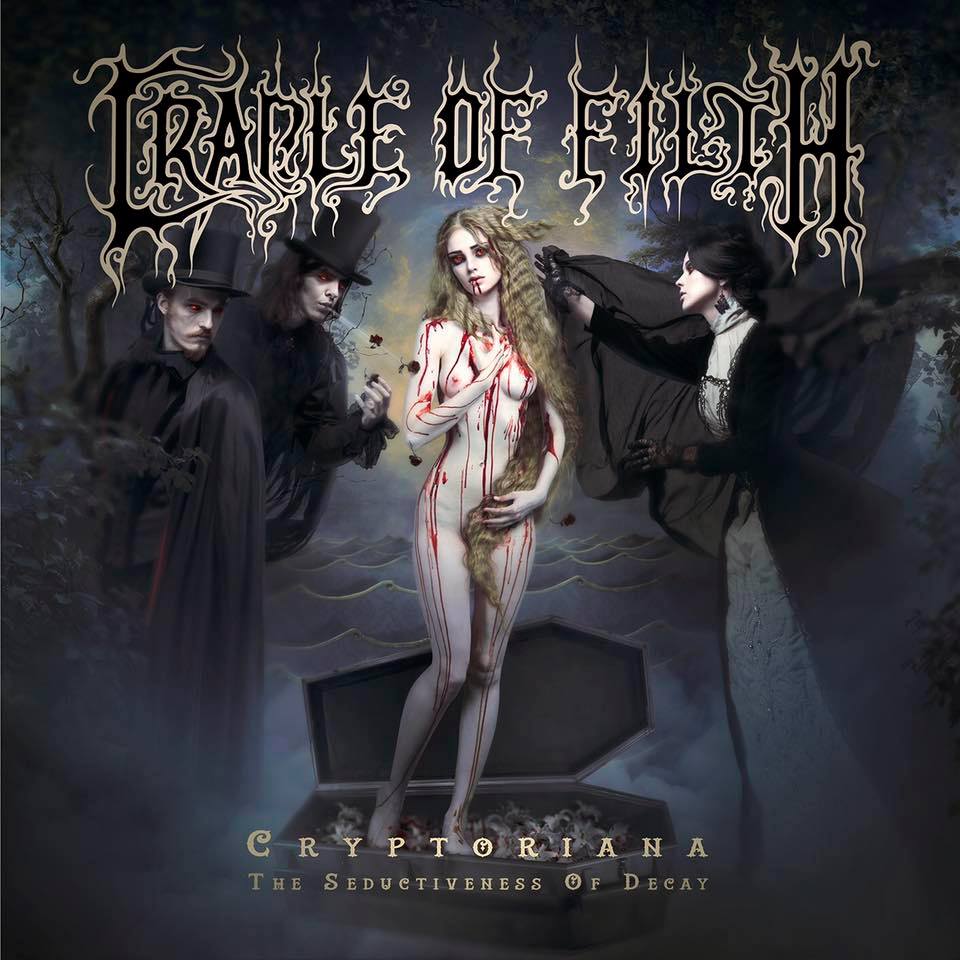
After their 2015 majestic and imposing album Hammer Of The Witches, British Extreme Metal institution Cradle of Filth had the arduous task of maintaining such high level of malignancy, electricity and eroticism in their brand new opus, stylishly titled Cryptoriana – The Seductiveness of Decay, the twelfth studio album in their undisputed career. Despite not being as fantastic and cohesive as its predecessor, Cryptoriana – The Seductiveness of Decay still brings forward the classic sound by Cradle of Filth we all learned to love through the years, solidifying even more their already distinguished reputation among fans of extreme music.
The band’s iconic mastermind and vocalist Dani Filth said the album “is deeply infused with Victorian gothic horror and thus the title is a reflection of that.’Cryptoriana’ implies the Victorians’ infatuation with the supernatural, the grave and the ghoulish. And the subtitle, ‘The Seductiveness of Decay’, further cements this attraction to death and the glittering lengthy process of self-annihilation”. In addition to that, one very interesting fact about Cryptoriana – The Seductiveness of Decay is that this is their second album in a row with the exact same lineup, which for an ever-changing band like Cradle of Filth is a huge milestone. The artwork was also created by the same artist from Hammer Of The Witches, Latvian designer Arthur Berzinsh, and form that you can have a very good idea of how similar both albums are visually and musically speaking, although as aforementioned the band had an almost impossible mission to surpass Hammer Of The Witches in regards to its exceptional quality.
Exquisite Torments Await can be considered a 2-minute “expanded” intro, showcasing demented and dark noises together with the band’s characteristic melody and potency, already bringing forward their usual blast beats and devilish orchestrations. Well, Dani’s first high-pitched scream says it all. The following tune, the first single of the album titled Heartbreak and Séance, kicks off at full speed with the gentle but powerful guitars by both Richard Shaw and Marek “Ashok” Šmerda bringing balance to the havoc led by the flammable Dani and the insanely talented drummer Martin “Marthus” Škaroupka. In other words, it’s classic and modern Cradle of Filth united in a solid and exciting manner (and don’t forget to check the uncensored version for its official video, it’s definitely worth it). And in Achingly Beautiful, an esoteric beginning quickly explodes into Cradle of Filth’s unique Black Metal, feeling like two or three songs in one due to its complexity and all breaks and variations, with the keyboards by Canadian beauty Lindsay Schoolcraft generating an amazing vibe in the background, not to mention her always pleasant backing vocals.
The main riff in Wester Vespertine reminds me of some of the guitar lines from their 1998 cult album Cruelty and the Beast, more specifically from the classic “Thirteen Autumns and a Widow”, proving Dani knows how to blend the past, present and future of his band in a very cohesive manner. Moreover, Marthus continues his sonic onrush with his potent and unstoppable beats and fills, enhancing the song’s potency considerably. Then it’s time for Richard and Ashok to lead the epic intro in The Seductiveness of Decay, before the band speeds up the pace delivering a neck-breaking, smashing tune tailored for both old school fans and newcomers to the world of Cradle of Filth. Dani has an absolutely flammable performance with his demonic growls and screeches, with the music becoming a symphonic devastation halfway through it with highlights to the awesome solos by Richard and Ashok. And featuring Liv Kristine as a guest vocalist (turning it into some sort of “beauty and the beast” duo with Dani), Vengeful Spirit maintains the album at a high level of seductiveness, vileness and darkness, with Marthus being totally diabolical on drums whereas Lindsay continues to deliver delicate and whimsical key notes to bring more balance to the music.
Despite bringing the trademark wicked lyrics by Dani (“Purring the sweet tempered soughing / Of lucrative Savannah wind / Stirs the great flotsam of clouds that are vowing / To usher the evening in / Affecting the set of the reckoning sun / From burnished gold to crimson hue / Before this night is quite sorely undone / The Devil is coming for you”), You Will Know the Lion by His Claw doesn’t sound as inspired as the rest of the album, presenting generic guitar lines and no gripping moments at all; whereas a beyond imposing beginning, full of symphonic elements, opens the gates of hell for Dani and his bandmates to blast the mysterious and funereal tune Death and the Maiden. Furthermore, a somber shadow remains above the band from start to finish, with Dani spearheading the musicality with his satanic growls, while Marthus and Lindsay craft a truly powerful atmosphere with their respective beats and keys until the song’s hellish finale.
And if I were you I would certainly go for the special edition of the album, which contains two amazing bonus tracks that are worth your additional investment. The first one, named The Night at Catafalque Manor, brings more of Cradle of Filth’s renowned Symphonic Black Metal, with highlights to its amazing orchestrations and the rumbling bass lines by Daniel Firth. Then closing the limited edition we have a flawless cover version for Annihilator’s biggest classic Alison Hell (if you’re from another planet and has never listened to the original version, you can take a shot at it HERE), from their 1989 cult album Alice in Hell. This is indeed a superb tribute to this Canadian institute, and Dani simply nailed it like what he did in the past with other all-time metal hits like Iron Maiden’s “Hallowed Be Thy Name”, Slayer’s “Hell Awaits” and Venom’s “Black Metal”.
Dani and his Cradle of Filth still have a lot of fire to burn in their career, and Cryptoriana – The Seductiveness of Decay is a strong statement that they’re still relevant to the world of heavy music, being capable of producing excellent material year after year. Simply visit Nuclear Blast’s official webstore to pick your version of the brand new album by UK’s most visionary and hellish outfit in the history of extreme music, and be more than prepared for when Dani and his devilish horde take your city by storm with their live performances (if they haven’t done so yet).
Best moments of the album: Heartbreak and Séance, The Seductiveness of Decay and Alison Hell.
Worst moments of the album:You Will Know the Lion by His Claw.
Released in 2017 Nuclear Blast
Track listing 1. Exquisite Torments Await 2:15
2. Heartbreak and Séance 6:24
3. Achingly Beautiful 7:02
4. Wester Vespertine 7:24
5. The Seductiveness of Decay 7:38
6. Vengeful Spirit (feat. Liv Kristine) 6:00
7. You Will Know the Lion by His Claw 7:22
8. Death and the Maiden 8:48
Limited Edition Digipak/Vinyl bonus tracks 9. The Night at Catafalque Manor 7:31
10. Alison Hell (Annihilator cover) 5:01
Band members Dani Filth – lead vocals
Richard Shaw – guitars
Marek “Ashok” Šmerda – guitars
Daniel Firth – bass
Lindsay Schoolcraft – female vocals, keyboards
Martin “Marthus” Škaroupka – drums
Guest musician Liv Kristine – female vocals on “Vengeful Spirit”
Prepare yourself for a grim and murky fusion of old school and modern Swedish-inspired Death Metal by five Italian troopers in their path of destruction and killing.
Formed in 2009 by guitarist Jari, Italian Death Metal act Helslave is a Rome-based band taking its influences from the 90’s Death Metal and Melodic Death Metal Swedish scene, adding their personal twist to generate a mix of old and modern school metal music. After releasing a self-titled demo in 2010, followed by the EP Ethereal Decay in 2013 and their first full-length album An Endless Path in 2015, the band started playing shows all over Italy and Europe, sharing the stage with acts such as Grave, Asphyx, Havok, Hideous Divinity and Destroyer 666, also appearing at Metaldays in 2014, keeping themselves busy and always charged up to continue their path of destruction wherever they go.
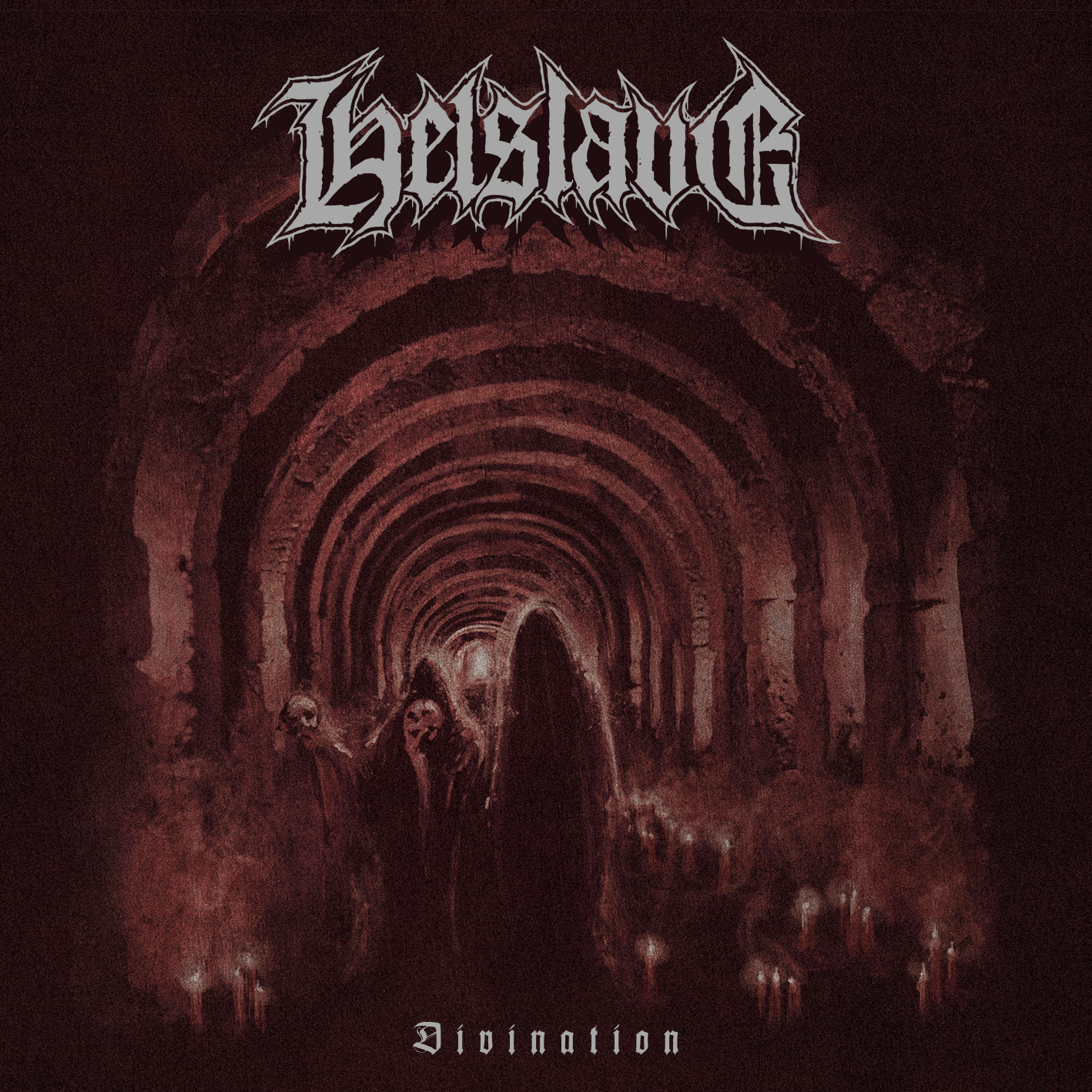
In the beginning of the year, Helslave entered the studio to record a brand new EP titled Divination, comprised of four brand new tracks leaning towards darker and heavier sounds, playing their already traditional Swedish-inspired Death Metal in the vein of Grave, Entombed and Desultor, all embraced by the devilish artwork designed by Misanthropic Art. Prepare yourself for grim and murky old school Death Metal, the kind of stuff that doesn’t rely on triggered blast beats, light-in-the-loafers warbling, or anything but the crudest building blocks to construct its killing art. Hence, although Divination lasts for only around 16 minutes, that’s more than enough for Helslave to crush your spine mercilessly.
In the opening track, beautifully titled Summoning The Eternal Eclipse, an ominous intro morphs into sheer devastation by Jari and his henchmen, with drummer Francesco Comerci dictating the song’s demented rhythm in a solid display of Swedish Death Metal. In addition, newcomer Diego Laino and his Unleashed-inspired vocals keep the song’s ferocity at an extremely high level, perfect for declaiming the song’s menacing lyrics (“Silence falls, it freezes all around / the arrival of divine / ancestral ritual summon / Blinding lights, no human eye can see / let the plague fall on the weak”). And there’s no time to breathe, as the band rises from the pits of hell with another brutal carnage named Lord Of Lies, presenting old school, visceral Death Metal with hints of other extreme genres such as Black and Thrash Metal to add more dynamism to the musicality. The guitar duo Jari and Lorenzo Fabiani are simply fantastic, blasting scorching, darkened riffs through their instruments, not to mention the intricate beats by Francesco in this ode to obscurity.
In The Spawn Of Astaroth, the band slows things down a bit, but that doesn’t mean they don’t fire truly dismembering riffs and beats, with Diego growling like a beast while Francesco and bassist Luca Riccardelli maintain a dense ambience in the background. Moreover, the final guitar lines exhale pure Black Metal, not to mention the song’s insurgent lyrics (“The fate of a great battle / has to be faced / an indomitable army has to be defeated / We are the ones who walk the left hand path / As written in the blood of the prophecy / The only way to conquer this land”). And Desecration, their last spawn of vicious Death Metal, is fast, demonic and amazingly neck-breaking, again presenting traditional piercing riffs and solos by Jari and Lorenzo as well as the complex and vibrant drumming by Francesco, being highly recommended for fans of Unleashed and Obituary.
You can take a full listen at Divination on YouTube, and follow Helslave through their Facebook page, YouTube channel, ReverbNation and SoundCloud. And if you want to show your true support to high-end underground Death Metal, you can purchase the EP at Helslave’s BandCamp or Big Cartel, at the Black Market Metal’s Big Cartel, or at Discogs. The only “issue” with Divination is that it’s only 15 minutes long, but as aforementioned that doesn’t stop Helslave from shining and destroying with their unrelenting Death Metal, leaving us eager for more kick-ass extreme music by this hardworking Italian squad.
Best moments of the album: Summoning The Eternal Eclipse.
Worst moments of the album: None.
Released in 2017 Black Market Metal
Track listing 1. Summoning The Eternal Eclipse 4:08
2. Lord Of Lies 3:32
3. The Spawn Of Astaroth 3:43
4. Desecration 4:35
Band members Diego Laino – vocals
Jari – lead guitars
Lorenzo Fabiani – guitars
Luca Riccardelli – bass
Francesco Comerci – drums
Inspired by the Roman Emperor Tiberius, here comes a ruthless Belgian Ritualistic Black Metal horde with their brand new and utterly fantastic concept album.
One of the most talented and prominent bands of the Extreme Metal independent scene in Europe, Belgian Ritualistic Black Metal horde Cult of Erinyes, is back with their unsparing music in the form of a concept album titled Tiberivs, inspired by the Roman Emperor Tiberius, who ruled one of the greatest empires of mankind from 14 AD to 37 AD. It doesn’t matter if you’re a newcomer to the dark world of this Brussels-based band or if you’re already a fan of works such as A Place to Call My Unknown, Blessed Extinction and their latest EP Transcendence, the music found in Tiberivs will leave scathing scars on your skin and poison your blood, leaving you eager for more of the band’s mordant creations.
As commented by the band’s mastermind Corvus, “I always perceived Cult of Erinyes as a portal that allows my mind to connect with different universes. I had, from the very beginning of the creative process, to immerse myself in a definite time period – the Ancient Roman Empire, Tiberius era. Each song, melody, and riff had to refer to a variation of emotions forgotten by time itself. What sounded like a fantastic challenge ended as a nightmare where my subconscious got lost. Desperation, frustration, and madness raised dangerously. This third album is our most progressive effort so far, but also contains radical and intense parts sublimed by Mastema’s urges for ferocity. We both went as far as we could on this album and were lucky to be helped in our task by longtime devoted musicians Algol (bass, additional guitars), Baron (lead guitars, artwork), and Déhà, who handled the drums, some guitars/keys, and the the mix/mastering process. Last but not least, Alex (Kall, Hypothermia, Craft) offered us a five-star bass-line on the intro and Marc DeBacker, my brother in Wolvennest, added some crystal-clear guitar sounds on the end of the album. This album also marked the end of my longtime musical and spiritual journey with Mastema. I can only but respect his decision and salute the energy he shared on Tiberivs. This concept album was his idea, and I’m glad we end our collaboration on this high and digressive note. He will be replaced for future live and recording duties by the most extreme and mentally extreme singer I know, Déhà, who is known for his work with Yhdarl, Maladie, We All Die (Laughing), and shitloads of other good projects. For all those reasons, I will hate and cherish this album. For Centuries To Come.”
In the opening track, titled Archaea, 41 B.C., fires burn amidst some eerie voices and moans, being slowly joined by the band’s atmospheric instrumental and topped off with a narration about how Romans were raised by wolves and that wolves are born to hunt and kill, resulting in a beyond ominous intro to the devastating Nero (Divine Providence), offering the listener the band’s old school Black Metal with their traditional ritualistic twist in the form of a sensational tempest of slashing guitars and blast beats. Moreover, not only Mastema sounds more devilish and brutal than ever, but the song’s frantic sounds are effectively blended with its ambient passages, turning it into a full-bodied blackened experience that’s definitely worth a listen. And in Casvs Belli, which means “an act or situation provoking or justifying war”, we’re treated to an explosion of extreme music with the demonic riffs by Corvus together with Algol and Baron generating a truly belligerent atmosphere, all enhanced by the infernal growls by Mastema and the obscure keys by Corvus.
Bred for War connects instantly and perfectly with the previous song to the point they can even be considered one major composition split in two, with sheer bestiality flowing from the awesome drumming by Déhà. In other words, this is straightforward Black Metal perfect for Corvus and his horde to tell the story proposed in the album; followed by Loner, a song that kicks off like a raging bull, smashing everything through the blast beats by Déhà and the fast and cutting guitars by Corvus, with Algol strengthening the song’s melody with his bass lines. The final result couldn’t sound more amazing, a furious and occult creation by Cult of Erinyes with an excellent job done by Mastema giving life to the song’s dark lyrics. Germanicvs, with its almost 8 minutes of blackened sounds and a demonic aura, keeps up with the foundations of Black Metal, being one of the most obscure and dense of all songs of the album led by the sustained drums by Déhà and spiced up by dark vociferations by Mastema.
An eerie, dark intro ignites another menacing creation by this talented Belgian horde, titled First of Men, a hybrid of Atmospheric and Ritualistic Black Metal with hints of Blackened Doom. Moreover, although it doesn’t show the same fury that emanates from the rest of the album, it’s still essential for the storyline. In Damnatio Memoriae (or “damnation of memory” in English), the music grows in intensity and darkness until after one minute it becomes a feast of Blackened Doom sounds enfolding the demented gnarls by Mastema, remaining rhythmic and dynamic thanks to the excellent job done by Déhà on drums until its thrilling Stygian ending; whereas For Centuries to Come is an 11-minute aria where Corvus showcases all his abilities as a multi-instrumentalist, while Mastema elevates his evil growls and screams to a whole new infernal level. This is by far the most complete and detailed of all songs, with its second half being a work-of-art of extreme music, not to mention its atmospheric elements beautifully complementing the piercing guitar riffs and solos, flowing into a fantastic and climatic conclusion to the album.
In a nutshell, the implacable Cult of Erinyes sounds stronger and more menacing than ever in Tiberivs (which can be enjoyed in its entirety HERE) and, despite being their ultimate album with the demonic Mastema on vocals, I’m sure the band will still provide us a lot of amazing material like this in the future. Furthermore, this brilliant concept album can be purchased at the band’s own BandCamp page, at the Caverna Abismal Records’ BandCamp or webstore, and at the Aural Music Webstore, as well as on iTunes, Amazon and Discogs. The roots to the greatest empire in the history of mankind are deeply connected to the lives of wolves, and there’s nothing better than the austere extreme music by Cult of Erinyes to show you how harsh, ruthless and vicious wolves can be.
Best moments of the album: Nero (Divine Providence), Loner and For Centuries to Come.
Worst moments of the album:First of Men.
Released in 2017 Caverna Abismal Records
Track listing 1. Archaea, 41 B.C. 2:40
2. Nero (Divine Providence) 7:42
3. Casvs Belli 6:24
4. Bred for War 3:52
5. Loner 4:27
6. Germanicvs 7:40
7. First of Men 5:49
8. Damnatio Memoriae 6:04
9. For Centuries to Come 10:59
Band members Mastema – vocals
Corvus – lead and rhythm guitar, bass, keyboards
Algol – bass, rhythm guitar
Baron – lead guitar
Déhà – drums, additional guitar & keyboards
Guest musicians Alex – bass on “Archaea, 41 B.C.”
Marc DeBacker – additional guitar on “For Centuries to Come”

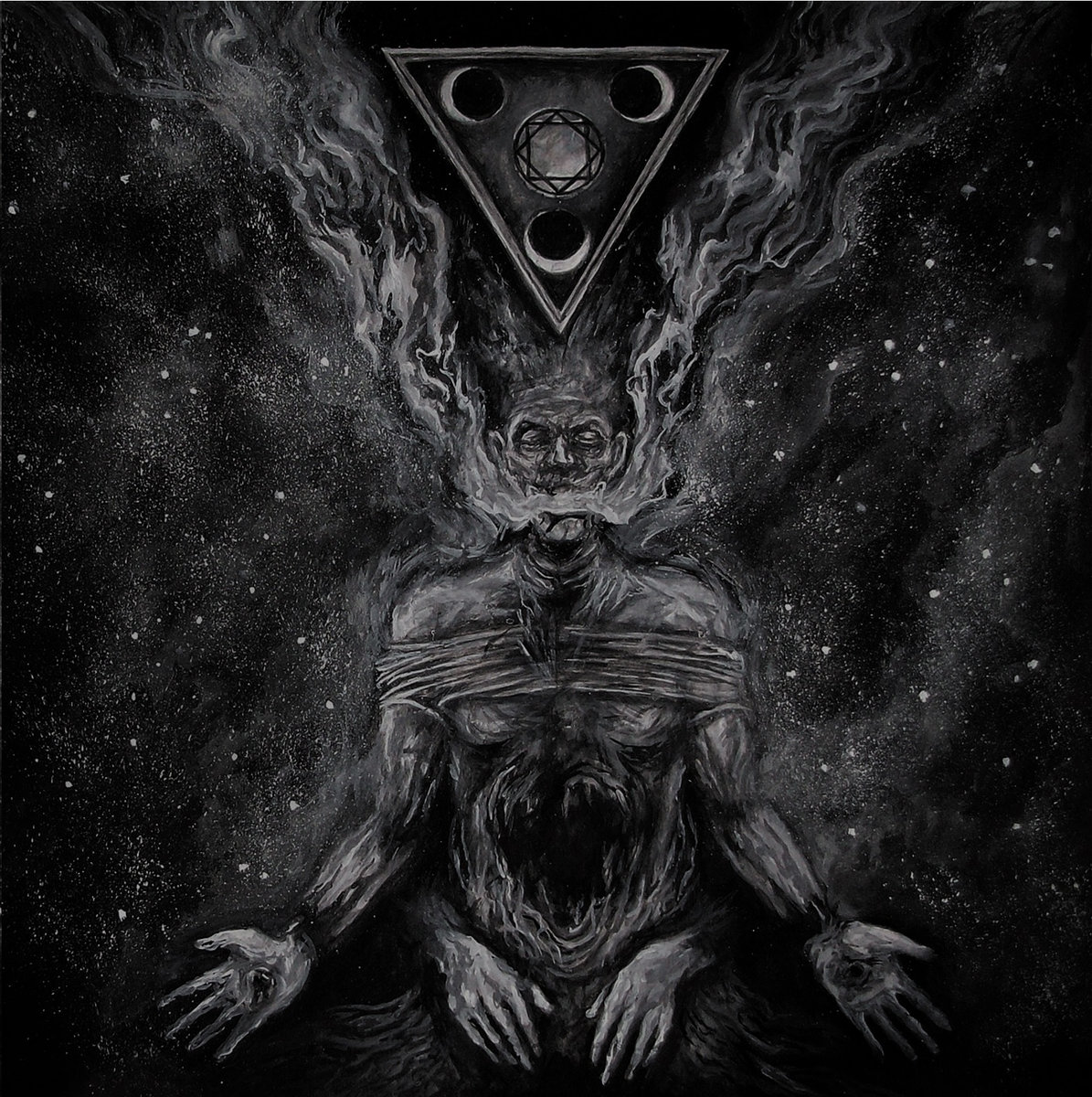 Forged in the scorching fires of Maracaibo, Venezuela in 2014 from the ashes of a band called Daemonhorn, but currently located in Colombia, old school Black Metal horde Theurgia are among us to blast pure hatred and violence with the release of their debut full-length album, titled Transformation. Recorded at Fenix Estudio in Barranquilla, Colombia, mixed and mastered at Dae Home Studio, and featuring an ominous album art created by John Quevedo Janssens (with the art in the digital edition being designed by the band’s own vocalist and guitarist Daemonae), Transformation brings all elements that make traditional Black Metal so compelling and menacing, helping the band carve their name in the history of underground South American extreme music.
 Transmutation (Of Synesthetic Formula) brings forward more of the band’s evil and obscure sounds, with Daemonae vociferating like a demonic entity while Teuterastus and Hellbeats threaten us all with their rumbling instruments, disturbing our senses until the songs climatic ending. Then we have My Oeneric Dreams, a short, ominous bridge to the visceral Procesio IV – Monotonous Chant, another song that begins in a Doom Metal fashion before exploding into a haunting feast of Black and Death Metal. This is a top-notch blackened aria where Hellbeats sets fire to the musicality with his drums, while Mortum P. distils his sulfuric riffs mercilessly. If you’re a fan of vile Blackened Death Metal, this song is simply tailored for your avid inner demon.







 THE HEADBANGING MOOSE